

After Meta Muse
What Personal Assistants Mean for Banking

A Tuesday night in September
Dana opens Muse on a Tuesday night to ask whether she can afford a weekend away in October. She connected her accounts the week the assistant launched, so Muse already knows what she has. It answers her question. Then it tells her two things she didn't ask about.
Her savings account at the bank is holding $8,400 and paying 0.1%. An online savings account would pay about 4% on most of it, roughly $240 a year on $6,000 instead of $6. And her rent autopay hits Friday, two days before payday. Her checking balance won't cover it.
Muse can't move the money yet. Its bank connection is read-only. So it tells her what to move and where, and she does it herself in about four minutes. Six thousand dollars leaves for a fintech savings account. Three hundred more moves from savings to checking ahead of Friday.
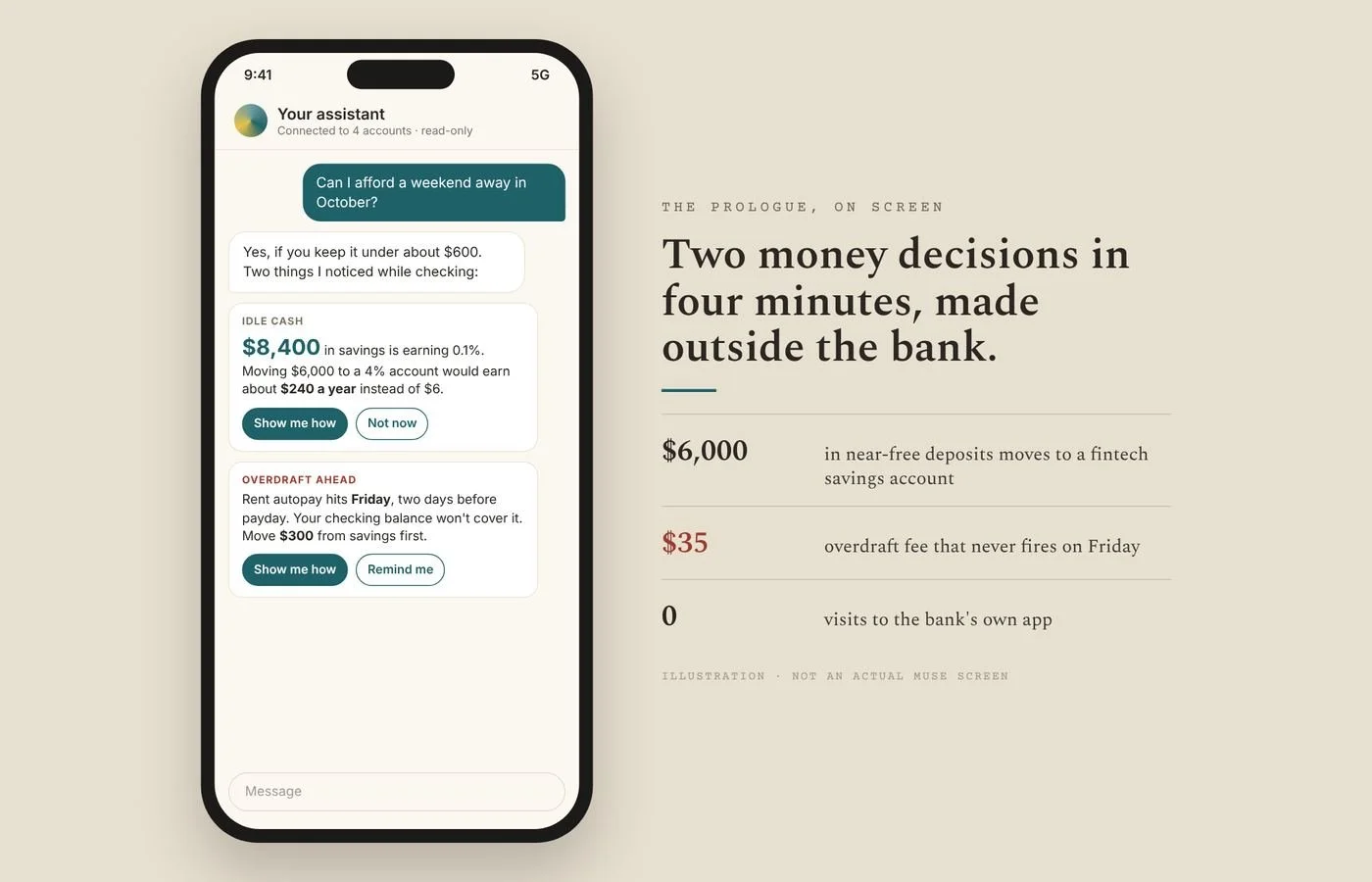
She never opened her bank's app. The bank lost $6,000 in deposits that cost it almost nothing, and the $35 overdraft fee it would have collected on Friday never fired. Both decisions happened in a few minutes, in a conversation the bank wasn't part of.
That Tuesday is already here. Meta launched Muse on September 8, 2026, connected to more than 12,000 U.S. financial institutions through Plaid. Ten days later it was the No. 1 app in Apple's App Store. On September 27, Apollo's chief economist, Torsten Slok, sent clients a note titled "Is an Agentic bank run coming?"
Most of the bankers and analysts who answered him said no, and they're probably right about the run. Depositor inertia is enormous. Jeff McMillan, who led firm-wide AI at Morgan Stanley, named the real risk: "What Torsten describes is repricing, not a run." A bank that has to pay market rates for every dollar, and can't collect a fee at the worst moment of a customer's month, is a different business.
Last week I published After Meta Muse for retailers. Banks and credit unions face the same shift, with more of their business model riding on it. I wrote Human Context for this problem. This paper is the banking version of that answer.
Personal assistants are the third shift in how Americans bank. Online banking moved the teller line to a screen. The app turned banking into a habit people check several times a week. The assistant reads every account a person has, at every institution, and tells them what to do with the money. It has no loyalty to the bank holding it.
The functional jobs of banking (checking a balance, paying a bill, finding a better rate, canceling a subscription) will move to the assistant first. Those jobs produce most of a bank's interactions and much of its cheapest funding. What the assistant can't read is the mode a customer is in when money goes wrong: the stress of a low balance, the panic of a scam, the scramble of an emergency expense.
Banks and credit unions that map their situational markets, then design for the modes inside them, can keep the relationship the assistant is trying to take over. The ones that keep monetizing those moments will hand them to Muse.
Online banking moved the teller line
In May 1995, Wells Fargo became the first major bank to let customers see their accounts on its website. Early online banking let you review activity and statements. Transfers and recurring bill pay came later. By 1999, one million Wells Fargo customers were using it. By 2010, 46% of American adults banked online, and by 2013 the figure was 51%, according to Pew Research.
Online banking changed where customers did the work. It didn't change who held the money. You went to your bank's website, logged in with your bank's password, and looked at your bank's numbers. Every interaction confirmed the relationship.
Banks designed deposit inertia into the channel. The customer had to come to you to see anything at all.
The app made banking a habit
The phone took the next step. In the FDIC's household survey, mobile banking was the primary way 34.0% of banked households reached their accounts in 2019. By 2023 it was 48.3%, while the teller fell from 21.0% to 15.1%. The American Bankers Association's annual survey tells the same story from another angle: 26% of consumers preferred the mobile app in 2017, and 54% did in 2025.
The app more than doubled as Americans' preferred way to bank
Share of U.S. consumers naming each method as the one they use most, ABA / Morning Consult national surveys
The app did two things to banking. First, it made the balance check the most frequent thing a customer does with a bank. In the companion analysis behind my banking workbook, the balance check alone accounts for 6.9 billion of the 18.6 billion banking occasions a year across 128 million U.S. households, more than a third of the total.
Second, it taught customers that the transaction should cost nothing. Chime reports around 25 million customers, most of them using it as their primary account. Fee-free apps won the everyday transaction on cost and speed, and banks answered with assistants of their own. Bank of America's Erica was used by 20.6 million clients in 2025 and handled nearly 700 million interactions.
Erica lives inside Bank of America's app and sees only Bank of America accounts. Muse and ChatGPT see every account a customer connects.
The assistant reads every account

Muse connects to bank accounts, cards, and investment accounts through Plaid, the same pipe most fintech apps use. The connection is read-only, and Meta says every action requires the user's approval. Within that limit, Meta says Muse tracks spending, analyzes statements, builds budgets, negotiates bills, and finds and cancels forgotten subscriptions. A New York Times reporter who gave it access had two duplicate subscriptions canceled and a $44.99 refund recovered. The basic version is free. Paid tiers run $20 and $100 a month, and Mark Zuckerberg has said Meta plans to charge a small fee on Muse transactions eventually.
OpenAI got there first. In May, it opened a personal finance preview inside ChatGPT, also built on Plaid and also reaching more than 12,000 institutions. OpenAI says more than 200 million people already ask ChatGPT financial questions every month. Smaller players are closing the loop on moving money: a San Francisco fintech called Rivo raised $3.1 million in August to sweep idle balances into Treasury bills and pull them back before bills are due. And Jamie Dimon told JPMorgan shareholders the bank would make it easier in 2026 for clients to move cash automatically between checking and higher-yield products.
The assistant is already in the customer's money
| Measure | Figure | Source |
|---|---|---|
| U.S. institutions Muse and ChatGPT can each read through Plaid | 12,000+ | Crypto Briefing; TechCrunch |
| People asking ChatGPT financial questions each month | 200M+ | OpenAI via TechCrunch |
| AI power users who rely on AI as their main money-management tool | 37% | PYMNTS Intelligence |
| Bank customers who have used gen AI to research bank products | 58% | Deloitte |
| Banking consumers who highly trust AI output for banking decisions | 29% | Rivel |
| Adults who trust their bank vs. AI as an information source | 85% vs. 62% | TD Bank |
So, what are you going to do about it? You can react to Muse. Or you can think two steps ahead (or more). I built a workshop and workbook for this kind of challenge, called Human Context for Consumer Banking.
The workbook follows Brightwater Bank, a composite regional bank, through six working sessions. It helps you think about how to keep the customer relationship as AI moves between your institution and the people you serve, using real-world data and the principles of Human Context.
§ The end of inertia
Be honest about why deposits stay. Some of it is the relationship. A lot of it is that moving money takes time nobody has.
The national average checking account pays about 0.1%. Online banks and fintechs pay 3.3% to 5%. On $10,000, that's the difference between about $10 a year and about $100. Simon-Kucher estimates that about two-thirds of U.S. deposits sit in near-zero-interest accounts, 10% to 15% earn 1% to 2%, and about a quarter earn 3% to 5%.
Most deposits pay almost nothing
Approximate share of U.S. deposits by rate earned, Simon-Kucher estimates
The Financial Times counts $1.6 trillion of non-interest-bearing deposits at JPMorgan Chase, Bank of America, and Wells Fargo alone, 16% of their liabilities. If those balances earned 3%, annual costs at the three banks would rise by about $47 billion. Mercer Capital's method for valuing sticky, low-cost deposits puts the equity value tied to them across U.S. banks at around $500 billion. Banks earn about two-thirds of their income from the spread between what they pay on deposits and what they earn on loans.
Customers already move money when they notice. In 2022 and 2023, more than $1 trillion left bank deposits for money market funds. J.D. Power's 2026 study found that 20% of customers had moved money out of their primary bank in the previous three months, up from 17% a year earlier, and the average customer now holds deposit accounts at three different institutions. An assistant watching all three will notice a rate gap long before the customer would.
What moves to the assistant, and when
Nobody has yet published a credible forecast for how much money assistants will move. The estimates that exist size the market for AI software in financial services (Mordor Intelligence puts agentic AI there at $7.78 billion in 2026), which tells you nothing about deposits. But we do know how much is exposed.
My projection follows the same logic as retail. Functional jobs move first, then the considered decisions, and the household's financial life system comes last.
Read-only assistants build budgets, cancel subscriptions, negotiate bills, and compare rates. Customers move the money themselves when told.
Fee income at the edges, and its most rate-aware deposits first.
Customers delegate routine moves: sweeping idle cash and bringing it back before bills, switching savings accounts, refinancing. Morgan Stanley Research estimates AI could double the share of borrowers who refinance or prepay mortgages.
The overdraft fee, which gets hard to collect from anyone with an agent.
Becomes the household's financial system, the place money decisions start and end.
The interface. Without a job the assistant can't do, it becomes the balance sheet behind someone else's.
The pace depends on two things outside any bank's control: whether authentication standards let agents act safely, and how the CFPB rewrites its open banking rule. Experts quoted by American Banker named low trust in agents, missing authorization controls, and unresolved liability as the main brakes. Those brakes will slow the second phase, but the first is already underway.
Situational markets
Muse is good at situations. It sees the paycheck land, the balance drop, the bill come due, the duplicate subscription renew. It reads situations better than any tool most banks have deployed, because it sees every account at once.
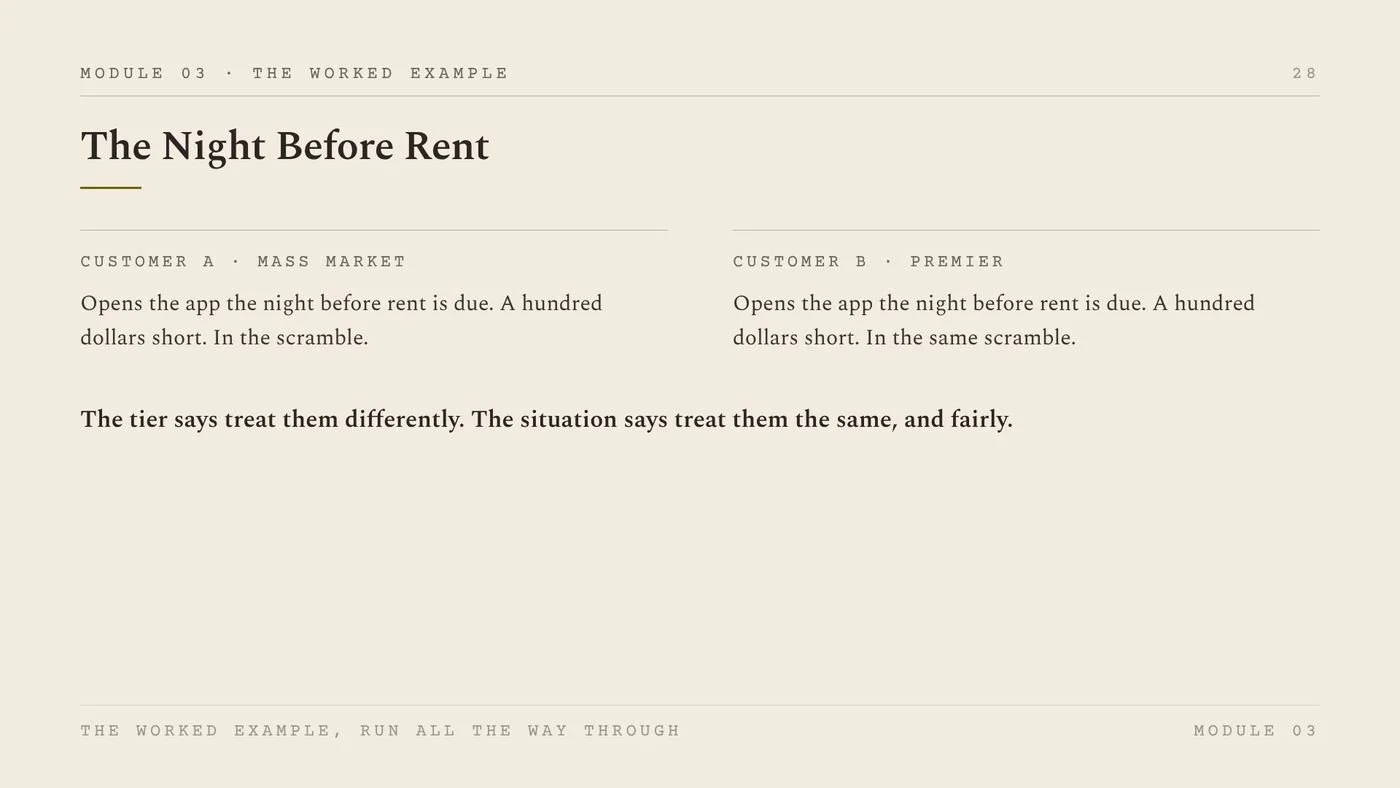
A situational market is a recurring situation that creates predictable demand. Most banks sort customers by product and balance tier instead: mass market, preferred, premier. A balance tells you what a customer holds. It tells you nothing about what they're living through on the Tuesday their account runs low.
Brightwater Bank, the composite regional bank in my workbook ($84 billion in assets, 4.5 million retail customers, 610 branches), replaced its tiers with 21 situations written in the customer's words and sized across 128 million banked U.S. households. Together they generate 18.6 billion customer occasions a year. Six reached Tier 1, three reached Tier 2, and twelve sit in Tier 3.
Brightwater's highest-volume situations, and how exposed each is to an assistant
Annual instances across 128M banked U.S. households, from the companion Brightwater analysis (an illustrative model)
| Situation | Inst./yr | Tier | Assistant exposure |
|---|---|---|---|
| When I check my balance and transactions to see where I stand. | 6.9B | 1 | High |
| When my paycheck hits and I need to move money, pay bills, and see what's left. | 2.8B | 1 | High |
| When I need cash and have to find an ATM or branch. | 2.2B | 1 | Low |
| When I need to pay a bill before it's late. | 1.5B | 1 | High |
| When I want to send money to a friend or family fast. | 1.5B | 1 | Medium |
| When prices keep rising and my money doesn't stretch like it used to. | 1.1B | 1 | High |
| When my balance gets low and I'm scared a payment will bounce. | 563M | 2 | High |
| When I'm juggling which bills to pay first this month. | 410M | 2 | High |
| When I'm trying to save for something and can't seem to get ahead. | 384M | 2 | High |
| When a scam or fraud attempt targets me and I panic about my account. | 179M | 3 | Medium |
Exposure is my assessment of how much of the job an assistant can do today or soon. Instances and tiers: Brightwater Consumer Banking Analysis, Frequency Model (illustrative)
Look at the shape. Every Tier 1 situation is a routine transaction, and five of the six are functional jobs an assistant already does or soon will. Cash access is the exception, because it's physical. These are the same moments fee-free apps already contest. Brightwater's team put it bluntly in the workbook: the bank was busiest where it was most replaceable and quietest where it mattered most.
The situations where trust is decided (an overdraft scare, an emergency with no cushion, a scam, a job loss, the day a customer finally notices the fees) all sit lower on frequency. Muse will see them too, and it will answer each one the same way, whatever state the customer is in.
Customer modes
A situation tells you when a customer needs you. A mode tells you how. A mode is a temporary mindset and set of behaviors, with a beginning, a duration, and an end. Two customers can hit the same low-balance situation in completely different modes. One is calmly moving money between accounts. The other is frozen at the register, sure the card will decline.
In the workbook's research session, a customer checks her balance, sees it's low, closes the app, and doesn't open it again for nine days. By every internal metric, the app worked. It loaded fast and showed the right number. She was in avoidance mode, afraid of the balance, and the app had nothing to offer her except the number she was afraid of.
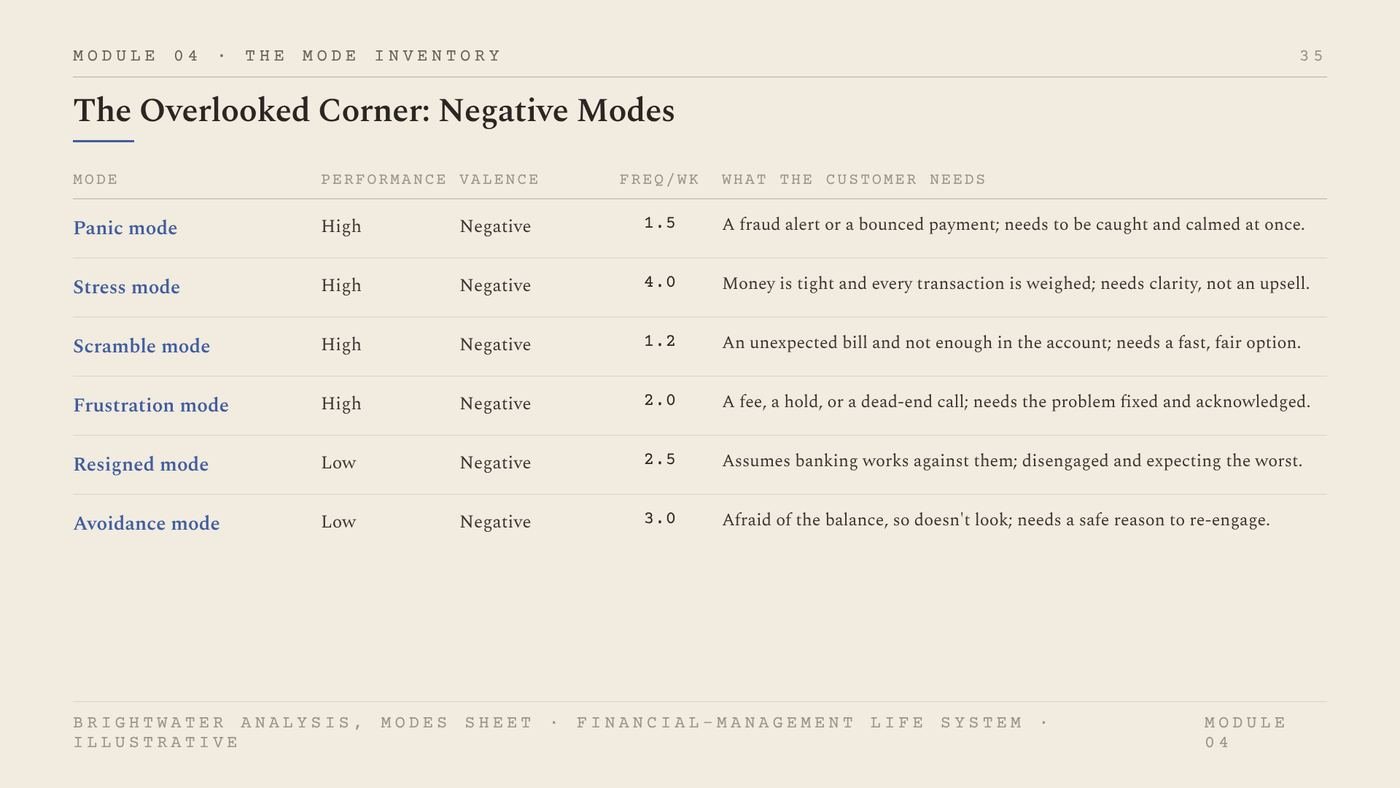
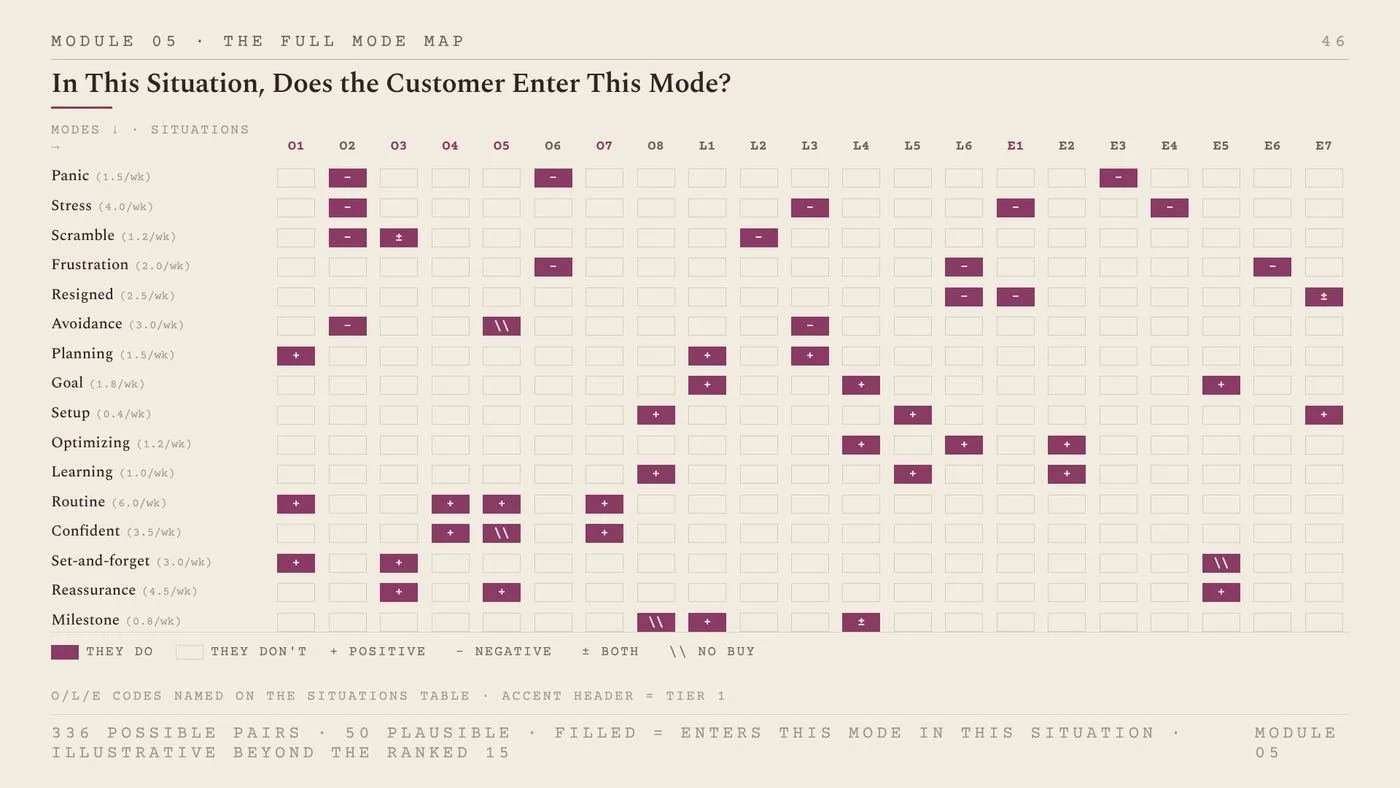
Brightwater's inventory found sixteen modes across the four corners of the book's two axes: performance (how much energy the mode demands) and valence (whether the customer experiences it as positive or negative). Routine mode is the most frequent, at six times a week. Stress mode runs four times a week. Panic, scramble, frustration, resignation, and avoidance fill out the negative side.

Same situation, different mode, one assistant answer
Modes and needs from the companion Brightwater analysis; the assistant's answer is illustrative
| Situation | Mode | What the customer needs | Muse's answer |
|---|---|---|---|
| Balance gets low | Stress | Clarity, not an upsell | Move $200 from savings before Friday |
| Balance gets low | Avoidance | A safe reason to look again | Move $200 from savings before Friday |
| Balance gets low | Reassurance | A calm yes that the payment cleared | Move $200 from savings before Friday |
| A scam targets me | Panic | To be caught and calmed at once | Lock the card, file the dispute |
| Unexpected expense | Scramble | A fast, fair option | The cheapest credit, wherever it is |
| Paid off a card | Milestone | Acknowledgment, not a pitch | Here's how to optimize next |
Muse gives the right functional answer every time. It gives the same answer to the stressed customer, the avoidant one, and the one who only wanted reassurance. The emotional job inside the situation is where a bank or credit union can still be the one that showed up.
Brightwater served the positive, high-performance modes well (planning, goal setting, opening an account), because those modes lead to a product sale. The negative, high-performance modes got a fee, a hold, or a hold-music queue. The book calls that corner the most overlooked quadrant: the customer operating at high intensity, not by choice.
Only two of Brightwater's ten touchpoints cleared the bar
Time value (TWS) index by touchpoint, 1 to 10, against a bar of 7.0; Defining Moments in red
The two lowest scores belong to the two Defining Moments, the events that, in hindsight, decide the relationship. Fraud and dispute resolution scored 3.7: a scared customer handed a form and a queue. The overdraft moment scored 2.7, the lowest of anything Brightwater does, because at the instant a customer is most afraid, the bank's response is a $35 fee.
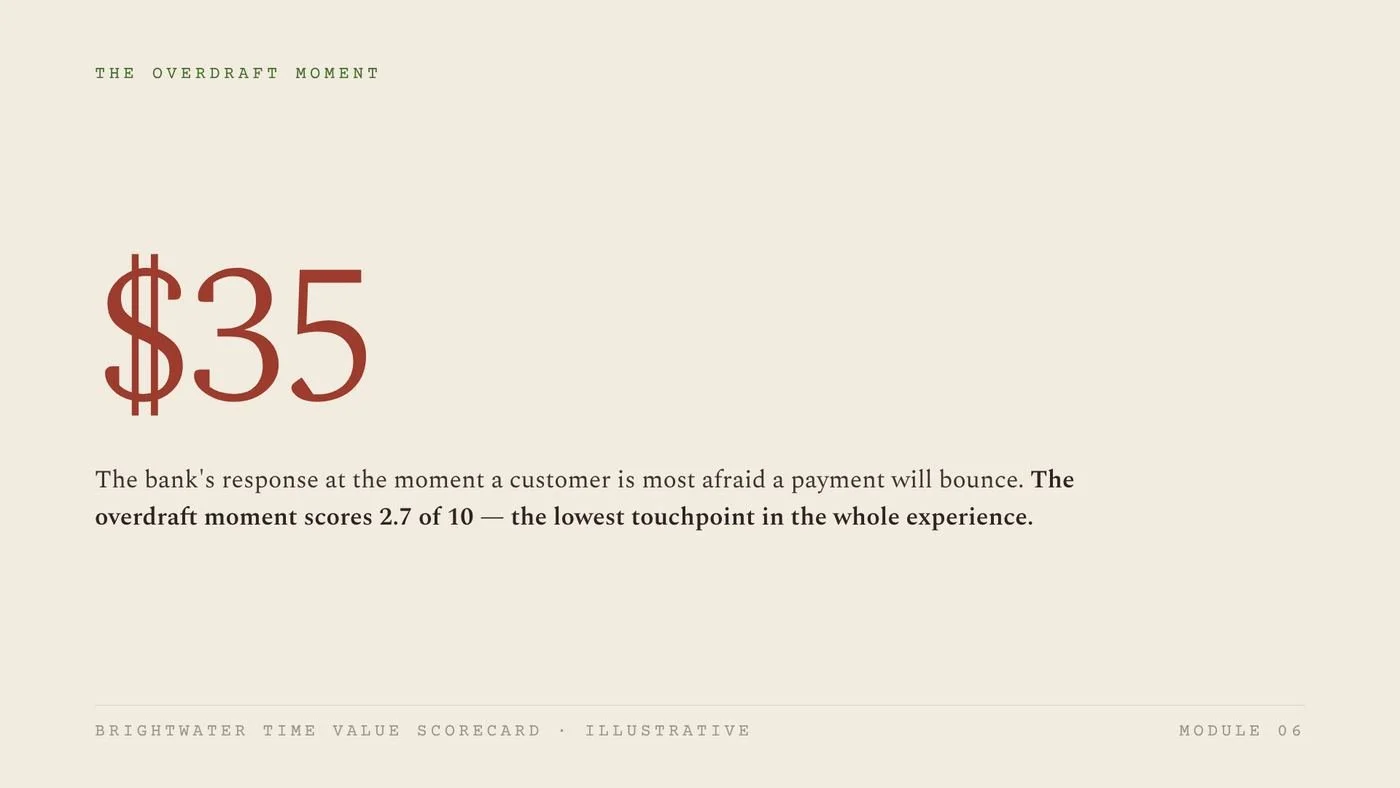
Now put Muse in that moment. The first useful thing a money assistant learns to do is see the overdraft coming and move money before it fires. If Muse is the one that saves the customer from the $35, Muse gets credit for showing up in the stress, and the bank loses the fee and the moment at the same time.
What the assistant takes, and what's left
Customers hire a bank to get five kinds of jobs done: functional, emotional, social, aspirational, and systemic. The systemic job is the one that holds the others together: help me manage the different domains of my life.
| Job | What the assistant does | What the bank has to do |
|---|---|---|
| Functional | Checks balances, tracks bills, cancels subscriptions, finds the best rate anywhere | Make routine banking invisible and agent-ready. Build your own sweep tools. |
| Emotional | Flags the problem and moves money. It can't calm anyone. | Design for stress, panic, and scramble. Rebuild the overdraft moment first. |
| Social | Splits the check, sends the transfer | Serve family money: the parent helping an adult child, the joint account, the relative who's struggling. |
| Aspirational | Tracks goals and optimizes yield | Mark the milestones (a first home, a paid-off card, getting out of the red) with a person who acknowledges them. |
| Systemic | Wants to become the household's financial system | Hold the license, the deposit insurance, the fraud protection, and the trust. Be the institution the assistant has to go through. |
The functional job is where banks have spent the last fifteen years of digital investment. It's also the job the assistant does best. The other four are where the relationship lives, and Brightwater's scorecard shows how rarely a bank designs for them. The branch visit, the one in-person touchpoint in the set, tied the balance check for the highest score.
The life system and trust
Muse is after the systemic job. People build life systems, organized sets of tools, routines, and relationships, to hold their lives together. Human Context names nine. Banking lives in one of them, financial management, and borrows its most important moments from others: routine responsibilities when a bill is due, family togetherness when money goes to a struggling relative, emotional wellbeing every time the balance runs low.
An assistant that reads every account, every bill, every subscription, and every calendar entry is applying for the financial management system itself. The bank becomes one data source among many.
The pipe that feeds it is already contested. In September 2025, JPMorgan reached a paid data-access deal with Plaid. The CFPB's open banking rule, finalized in October 2024 to give consumers free access to their own financial data, has been enjoined by a federal court and is being rewritten, and the question of whether banks may charge for that access is open again. Whoever wins that fight decides how cheaply an assistant can sit between a bank and its customers.
Trust is the bank's strongest card. TD Bank's 2026 survey found 85% of adults trust their bank as an information source, compared with 62% for AI. Deloitte found 72% of bank customers are hesitant to share details of their financial situation with gen AI tools. Muse's own record gives them reason. One early user reported it gave his home address to a Marketplace buyer without permission, Meta earns nearly 98% of its revenue from advertising, and Muse's terms of service say it isn't a licensed financial advisor, fiduciary, money transmitter, or financial institution.
That trust has limits. Gallup puts public confidence in banks at 62%, down from 76% before the 2008 financial crisis. Every fee charged at the worst moment of someone's month draws it down. Muse needs that trust to do the systemic job, and right now banks are the ones holding it.
Six steps for banks and credit unions
- Make your products readable and your accounts safe for agents
Publish rates, terms, and fees in a form an assistant can parse. Build toward FDX-standard data access whatever happens to the open banking rule. Decide now how a customer authorizes an agent, what it can do, and who is liable when it's wrong. Making your products easier for someone else's assistant to read may seem counterintuitive. But if your institution is going to win with Human Context and AI, you have to be in the game.
- Build your own sweep tools
Repricing reaches the most rate-aware balances first. Give customers an automatic sweep and competitive savings inside your own institution before someone else's assistant moves the money for you.
- Name your situations
Write them in the customer's words as "When I…" statements. Size each one by incidence, population, and recurrence. Brightwater found 21 that generate 18.6 billion occasions a year.
- Find the signals you already have
Behavioral (a login right after a card decline), temporal (the two days before payday), life-event (a direct-deposit change), and environmental (a regional scam wave). Most of them already sit in your data, unused.
- Map the modes, then rebuild the stress moments
Start with the overdraft moment. Congress repealed the federal overdraft rule in 2025, so no regulator will force the change. You'll choose it, or Muse will make the choice for your customers.
- Measure time value
Replace the satisfaction average with a time-value index: did it do the job, was it worth the time, was the time any good. Score your Defining Moments first.
Three questions for your leadership team
If the answer is no, an assistant will route around you to an institution where the answer is yes.
Estimate it by product and rate band. That's the money an assistant will look at first.
Whatever it is, that's the moment Muse is learning to own.
Human Context for Consumer Banking
I wrote Brightwater Bank in July, before Muse launched. Read it now and it reads like a rehearsal. Each challenge in this paper has a module that works through it on a bank's own operations, with a blank worksheet for your team at the end.
| The challenge | What Brightwater found | Module |
|---|---|---|
| Customers judge you against the app that made money easy, and now against an assistant | An app fast at the transaction and blind to the situation; a customer who didn't return for nine days | 01 · Where the Goal Posts Moved |
| Assistants take the routine transactions | Every Tier 1 situation is routine; 21 situations, 18.6B occasions a year | 02 · The Situational Market |
| Balance tiers can't see what the assistant sees | Two customers a hundred dollars short the night before rent; the tier treats them differently | 03 · Retire the Balance Tier |
| Muse can't read modes | Sixteen modes; the stress modes get a fee, a hold, or a queue | 04 · Getting Into Customer Modes |
| The life system is contested | Investment concentrated where the bank is replaceable, thin where it's decisive | 05 · Life Systems and the Mode Map |
| Inertia ends; every touchpoint has to earn its keep | Two of ten touchpoints clear the 7.0 bar | 06 · Measuring Time Value |
| Defining Moments decide who keeps the customer | Overdraft at 2.7 and fraud resolution at 3.7, the two lowest scores | 06 and the closing synthesis |
Brightwater Bank is an invented composite. The bank is made up; the problems are real
Three ways in
 The book
The full method: situational markets, modes, life systems, and time value, with the research behind each.
The workbook
Six modules and blank worksheets your team can fill in with your own numbers, plus the Brightwater case study.
Two virtual two-hour sessions about three weeks apart. Your team leaves with a first map of your situational markets, frequency estimates on the largest, a situation calendar, and a 90-day plan.
To book the workshop or talk through what Muse means for your institution, email me at davenorton@stonemantel.co.
The assistants are already reading the statements. The only question left is whether they will move the money somewhere else.
Notes
- Crypto Briefing, "Meta's Muse AI agent partners with Plaid to access 12,000 financial institutions," Sept. 25, 2026.
- Kim Lyons, "Muse AI can help manage your money now, but what actually happens when you let it in?" Yahoo Tech, Sept. 29, 2026 (citing Meta, the New York Times, and Muse's terms of service).
- PYMNTS, "AI Agents Wake Up $1.6 Trillion in Sleepy Bank Deposits," 2026 (citing the Financial Times, Torsten Slok, the Wall Street Journal, McKinsey, and PYMNTS Intelligence).
- Omkar Godbole, "AI agents could drain cheap bank deposits, Apollo's Torsten Slok warns," CoinDesk, Sept. 28, 2026.
- Penny Crosman, "AI agent bank runs possible but unlikely, experts say," American Banker, Oct. 1, 2026 (citing Simon-Kucher).
- Traders Union, "U.S. banks face $500bn valuation risk as AI agents push savers toward higher rates," Oct. 7, 2026 (citing the Financial Times and Mercer Capital).
- Ivan Mehta, "OpenAI launches ChatGPT for personal finance, will let you connect bank accounts," TechCrunch, May 15, 2026.
- J.D. Power, 2026 U.S. Retail Banking Satisfaction Study, via Business Wire, March 2026.
- American Bankers Association / Morning Consult, national surveys of preferred banking methods, 2017–2025, via ABA Banking Journal and CPA Practice Advisor.
- FDIC, 2023 National Survey of Unbanked and Underbanked Households, 2024.
- Pew Research Center, "51% of U.S. Adults Bank Online," Aug. 7, 2013.
- Wells Fargo History, "First in online banking."
- Bank of America, "BofA AI and Digital Innovations Fuel 30 Billion Client Interactions," March 10, 2026.
- TD Bank, U.S. AI Insights Report, March 2026, via EMARKETER, May 22, 2026 (also citing Gallup).
- Deloitte, bank customers and generative AI, via ABA Banking Journal, Sept. 1, 2026.
- Corey Wrinn, "Consumers are Using AI to Find Their Next Bank, But Still Don't Trust Its Advice," The Financial Brand, Feb. 3, 2026 (Rivel Banking Research).
- Open Banking Tracker, "Section 1033 Status Tracker," reviewed June 2026.
- Stone Mantel, Human Context for Consumer Banking and the companion Brightwater Consumer Banking Analysis, July 2026.
- David W. Norton, Ph.D., Human Context: How Intelligent Companies Build Customers, 2026.
Brightwater Bank is an invented composite regional bank, not a real business. Its figures come from a companion analysis Stone Mantel built for the workbook; the inputs are illustrative composite estimates chosen to demonstrate the method, not findings from a real bank. Prologue scenario is illustrative. © Stone Mantel 2026.