

After Meta Muse
What Personal Assistants Mean for Fast Casual Restaurants
A Tuesday at 12:10
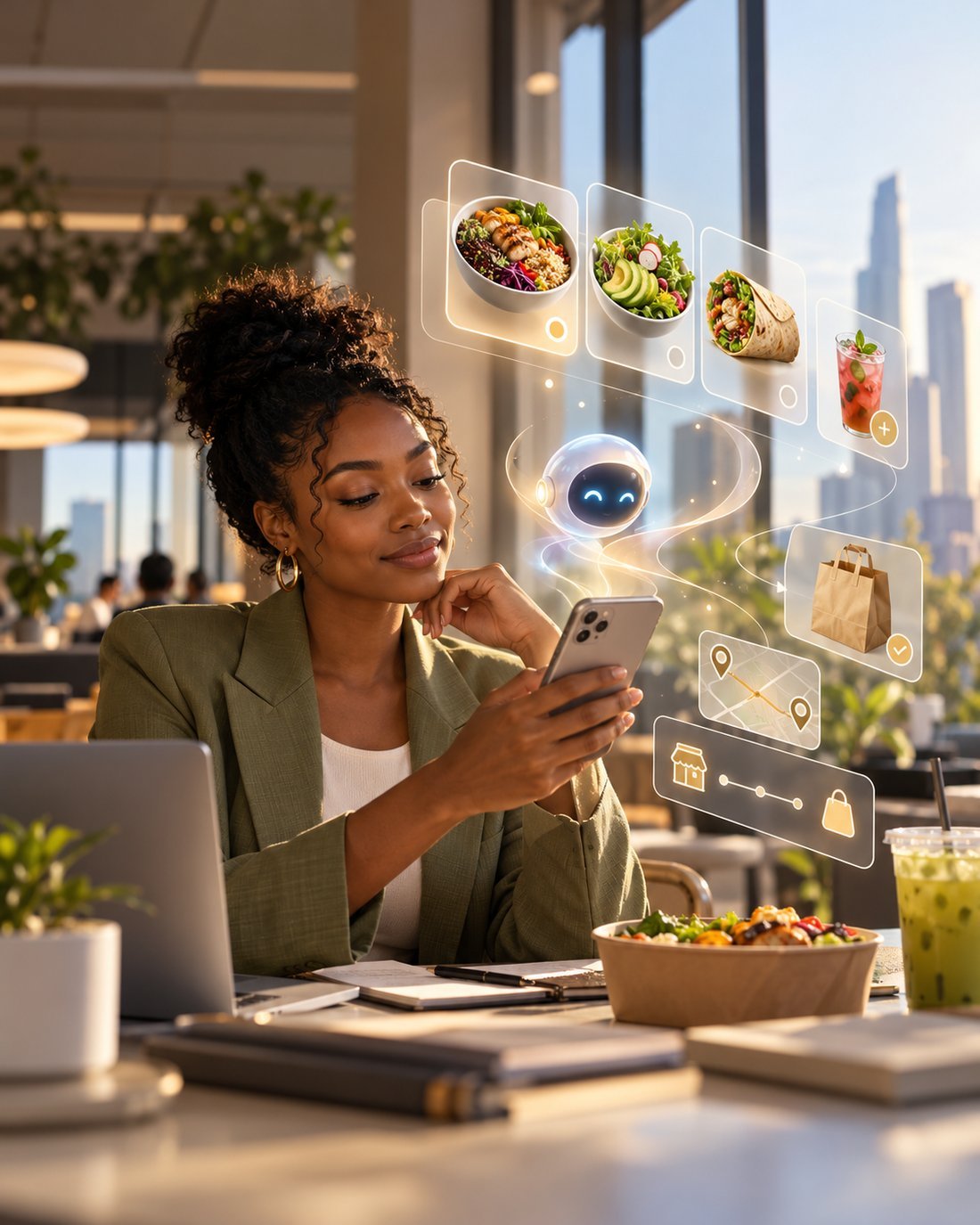
Jess has eleven minutes between meetings. She texts her assistant: lunch, something with protein, under $15, ready by 12:30.
For three years she has ordered the same bowl from the same fast casual chain twice a week. The assistant knows that. It also knows the bowl now costs $14.85, up from $12.40 last fall, and that a bowl place two blocks over has a comparable build for $11.90 with a first-order coupon on a delivery app. It places that order. Jess taps once to confirm and goes back to her slides.
She never opened her usual chain's app. Her loyalty points didn't post, the combo upsell never loaded, and the chain has no record that she was hungry at noon and went somewhere else. Next Tuesday the assistant will remember that the new place was fine.
That Tuesday is already here. Meta launched Muse on September 8, 2026, with checkout built on Stripe's Link. On September 30, DoorDash opened a waitlist for an agent that lives in Apple's Messages app. You text "order my usual," it builds the cart from your history, and you confirm in the thread. DoorDash is also in talks with Meta about an official connection to Muse, according to Bloomberg.
Last week I published After Meta Muse for retailers, and this week a version for banks. Fast casual may move faster than either. The order is small, it repeats, the guest already knows what she wants, and most of it is digital already. I wrote Human Context for this problem. This paper is the fast casual version of that answer.
Fast casual moved the order onto the phone years ago, and the next shift takes the chain's app out of the order. Personal assistants and delivery agents will place the routine order, the usual lunch and the reorder, without the guest opening the chain's app, seeing its upsell, or scanning its loyalty code.
The routine Tier 1 situations are the ones an assistant reads best from order history. What it can't read is the guest's mode: the rushed lunch, the budget-panic order, the diet-guilt menu decision, the wrong order that needs fixing. Those are the moments chains run worst today, and the doubt about price now comes up as often as the order itself.
Chains that map their situational markets and design for the modes inside them can keep the guest relationship. The ones that keep answering every mode with an upsell will become a kitchen inside someone else's assistant.
The order is already digital
Fast casual did the hard part of digital years ago. Chipotle placed 38.3% of its Q2 2026 sales digitally, $1.3 billion in the quarter, up from 35.5% a year earlier. Sweetgreen is further along, with 66.3% of revenue digital and 38.8% through its own channels. PYMNTS projected that 70% of QSR sales would be digital by the end of 2025.
Loyalty followed the app. PYMNTS Intelligence found that 48% of diners belonged to a restaurant loyalty program in 2025, and 47% engaged with one weekly, up from 34% in 2023. Circana puts loyalty members behind 39% of restaurant visits, roughly double the 2019 share. At Chipotle, nearly 90% of digital transactions scan for rewards, compared with about 20% in the restaurant.
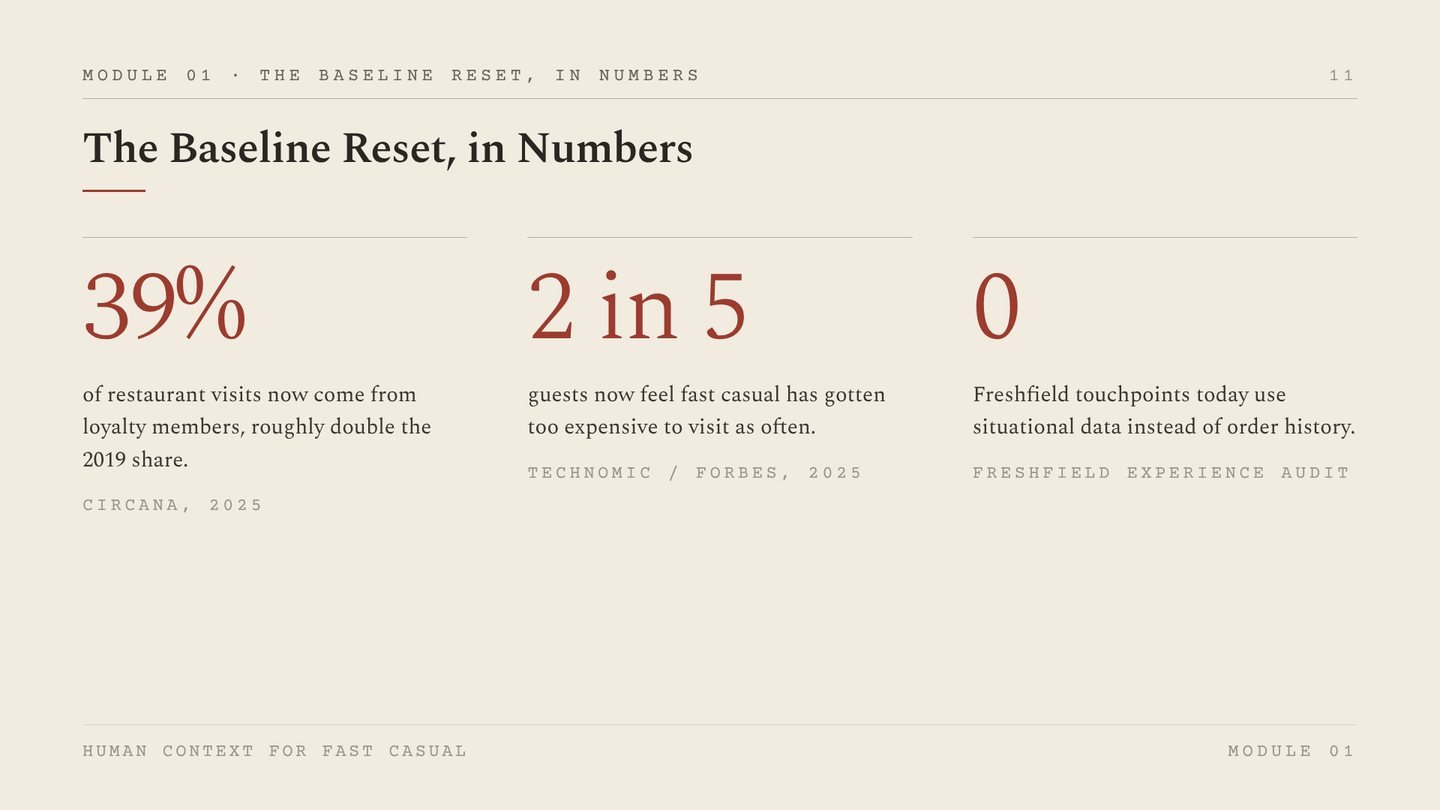
The app gave chains three things at once: the guest's order history, a screen to sell from, and a loyalty record to bring her back. Every one of those depends on the guest opening the app.
The same research shows what guests want from it. Sixty-eight percent strongly want apps that remember their past orders. Order accuracy ranks third among the drivers of perceived value, behind price and quality. An assistant can remember the order without the app, but the kitchen still decides whether the order arrives right.
Meet Muse, and the agents behind it

Muse got off to a rough start with food. PYMNTS tested it on three errands the day after launch: reordering toilet paper on Amazon, ordering a pizza from Domino's, and booking a table on Resy. None of the three went through, mostly because of setup problems such as sharing account credentials and connecting email and calendar. Muse routes payment through Stripe's Link, and Meta says it is the first agent covered by Link's purchase protections. Mark Zuckerberg has said Muse could pay for itself, with Meta taking "a very small cut of whatever the transaction is."
The setup problems will get fixed. The fee model matters more, because every order an assistant places puts a new party in the middle that wants a share.
The delivery platforms are moving faster than Meta. DoorDash's new agent matches a texter's phone number to her DoorDash profile, then uses her order history, preferences, and stored card. It can suggest a local spot, sort out mixed dietary needs for a group, and, with permission, text about a usual coffee order before the guest asks. An enterprise version lets a Slack bot collect a team's lunch requests and place one group order. DoorDash co-founder Andy Fang put the pitch plainly at the launch: "Every other AI agent is meeting you for the first time. We've known you for years."
Google is testing the same idea inside Gemini. In March, DoorDash and Uber began beta tests that let Gemini reorder food or book a ride on Pixel 10 and Galaxy S26 phones, with the user watching and able to step in.
The assistant is already in the order
| Measure | Figure | Source |
|---|---|---|
| Muse errands PYMNTS tested on day two that completed | 0 of 3 | PYMNTS |
| Ask DoorDash restaurant orders that went to a place the customer had never tried | Nearly half | DoorDash via PYMNTS |
| Lift in grocery checkout conversion after DoorDash added customer memory | ~24% | InfoQ via PYMNTS |
| Diners who strongly want apps that remember past orders | 68% | PYMNTS Intelligence |
| Diners comfortable using voice AI at the drive-thru | 60% | PYMNTS Intelligence |
So, what are you going to do about it? You can react to Muse. Or you can think two steps ahead (or more). I built a workshop and workbook for this kind of challenge, called Human Context for Fast Casual.
The workbook follows Freshfield Kitchen, a composite fast casual chain, through six working sessions. It helps you think about how to keep the guest relationship as AI moves between your restaurants and the people you feed, using real-world data and the principles of Human Context.
Three shifts and the end of inertia
§ The choice moves upstream
Today the guest opens a chain's app because that's the habit. With an assistant, she says "get me lunch, something healthy, under $15," and the assistant picks. The brand now competes inside a recommendation it doesn't control. Freshfield's workbook already tracks a situation for this, "when a delivery app pushes me somewhere else with a coupon," at 518 million occasions a year. With an assistant choosing, that situation becomes the normal path to lunch.
§ The order becomes a standing instruction
"My usual" is an agent's easiest job. In Freshfield's mode inventory, the two most routine modes are Regular, at six times a week, and Set-and-forget, at 2.5. An assistant serves both without opening an app, which means the reorder button, the menu flow, and the combo upsell lose most of their audience.
§ The relationship splits
The assistant holds the intent, the history, and the payment credential. The chain holds the kitchen, the food, and the moment something goes wrong. Loyalty points tied to the app stop counting when the guest never opens the app.
§ The end of inertia
A lot of fast casual loyalty is habit, and habit is the job an assistant takes over first. One-third of diners told PYMNTS their favorite QSR or fast casual brand changed in the past year, mostly on value and quality. Prices give them a reason to keep looking. Food away from home rose 3.4% in the twelve months to August 2026 and limited-service meals rose 3.2%, both faster than groceries at 2.2%. Technomic found two in five guests say fast casual has gotten too expensive to visit as often. Chipotle took about 1.6% in price in Q2 and guided toward the mid-2% range in Q3.
An assistant can compare price, protein, and wait time across five chains in the time it takes a guest to open one app. Nearly half of Ask DoorDash's restaurant orders already go to a place the customer has never tried. Every habitual order a chain counts on will now be checked against the competition before it's placed.
What moves to the assistant, and when
Nobody can say yet how fast guests will hand lunch to an assistant. DoorDash CEO Tony Xu told analysts in August that agentic order volume from AI partners was still low. But we do know how much is exposed.
Five of Freshfield's eight Tier 1 situations are routine orders: weekday lunch, the menu decision, building the bowl, solo dinner, and order-ahead. Together they account for 13.3 billion of the 21 billion occasions in the workbook's market model. Those are the orders an assistant takes first.
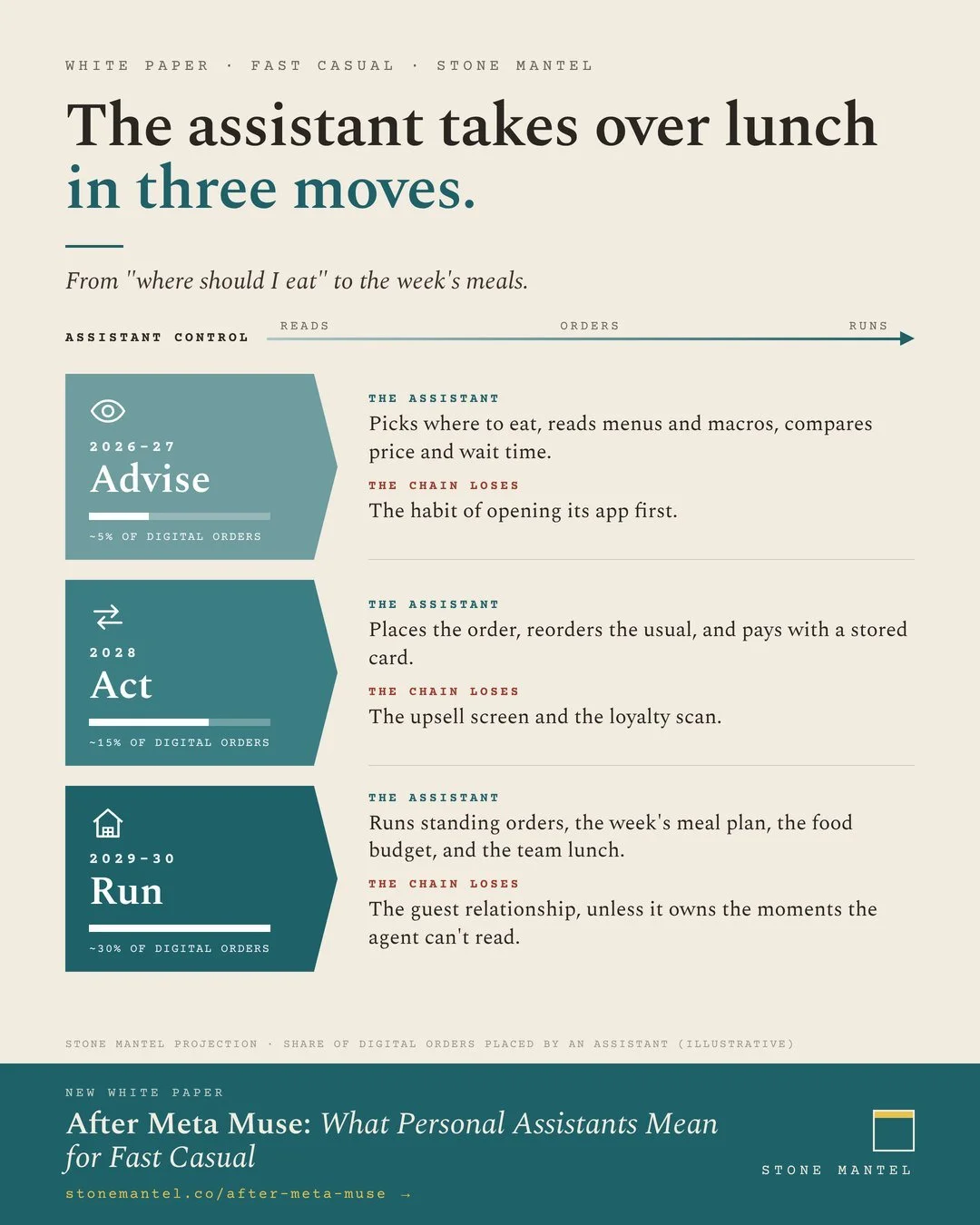
My projection follows the same logic as retail and banking. The functional jobs move first, then the order itself, and the household's food routine comes last. For Freshfield, holding sales flat:
| Stage | Window | What the assistant does | Share of digital orders | Through an assistant |
|---|---|---|---|---|
| Advise | 2026–27 | Picks where to eat, reads menus and macros, compares price | ~5% | ~$55M |
| Act | 2028 | Places the order, reorders the usual, pays with a stored card | ~15% | ~$165M |
| Run | 2029–30 | Runs standing orders, the week's meals, the food budget, and group orders | ~30% | ~$330M |
Stone Mantel projection (illustrative). Assumes Freshfield's 58% digital mix holds. Excludes orders an assistant steers to a competitor, which is the larger risk
Every agent-routed order costs the chain more than the commission. It loses the loyalty scan, the upsell screen, and the data about why the guest ordered. When the assistant also takes a fee, the chain is paying two intermediaries for a guest it used to reach directly.
Situational markets
Muse is good at situations. It sees the calendar fill up at noon, the meeting that runs late, the usual order on a Tuesday, the price that went up since last month. A situational market is a recurring situation that creates predictable demand. Most chains plan by daypart instead: breakfast, lunch, afternoon, dinner. A daypart records when the register rings, which says little about what the guest is deciding.
Freshfield Kitchen, the composite chain in my workbook (740 locations, $1.9 billion in system sales, 14 million loyalty members, 58% of orders digital), replaced its dayparts with 21 situations written in the guest's words and sized across 115 million monthly fast casual guests. Together they generate 21 billion guest occasions a year. Eight reached Tier 1, five Tier 2, and eight Tier 3.
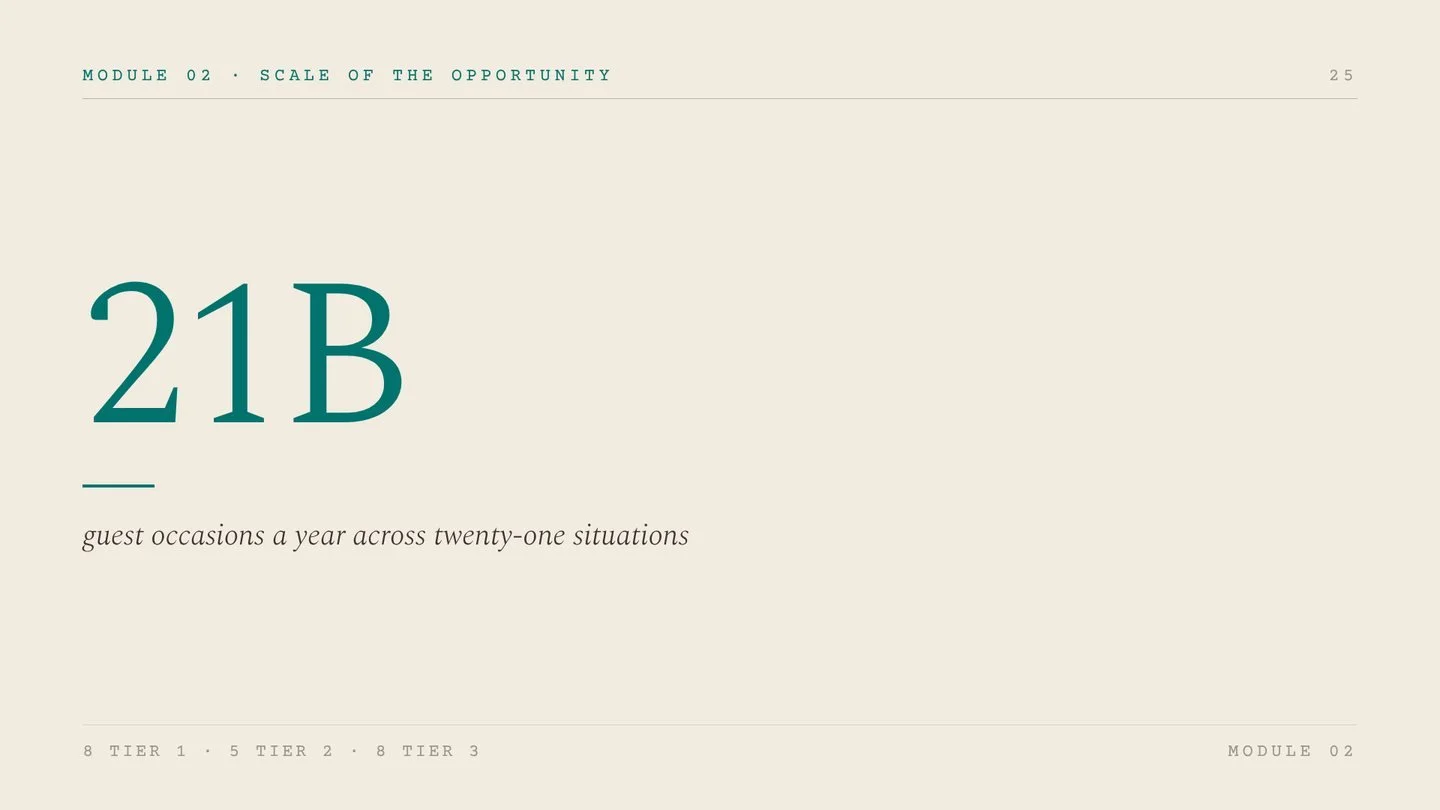
Freshfield's situations, and how exposed each is to an assistant
Annual instances across 115M monthly fast casual guests, from the companion Freshfield analysis (an illustrative model)
| Situation | Inst./yr | Tier | Assistant exposure |
|---|---|---|---|
| When it's noon and I need lunch fast but don't want junk. | 4.1B | 1 | High |
| When I'm deciding what to get and want my usual or something new. | 3.9B | 1 | High |
| When I build my bowl exactly how I like it. | 2.2B | 1 | High |
| When I grab a quick dinner solo after work. | 1.6B | 1 | High |
| When I order ahead on the app so it's ready when I arrive. | 1.5B | 1 | High |
| When prices keep climbing and I wonder if this is still worth it. | 1.4B | 1 | High |
| When I'm on a budget and every order feels like a splurge. | 1.1B | 1 | High |
| When I'm trying to eat healthier and need the food to help, not tempt. | 1.0B | 1 | Medium |
| When I'm feeding the family on a weeknight and nobody agrees. | 828M | 2 | Medium |
| When a delivery app pushes me somewhere else with a coupon. | 518M | 2 | High |
| When I have a dietary restriction and I'm scared something's in it. | 193M | 3 | Low |
| When the order's wrong and I need it fixed without a fight. | 138M | 3 | Low |
Exposure is my assessment of how much of the job an assistant can do today or soon. Instances and tiers: Freshfield Situational Markets Analysis (illustrative)
Look at the shape. Five of the eight Tier 1 situations are the routine order, and an assistant can do all five from order history. The other three are the guest questioning the chain: prices climbing, the budget squeeze, and the health goal. In Freshfield's model, the doubt now comes up about as often as the order.
The situations where trust is decided (an allergen scare, a wrong order, a food-safety story in the news) all sit in Tier 3. An assistant will see them too, and the fix for each still has to come from the restaurant: a replacement bowl, a straight answer about what's in the sauce.
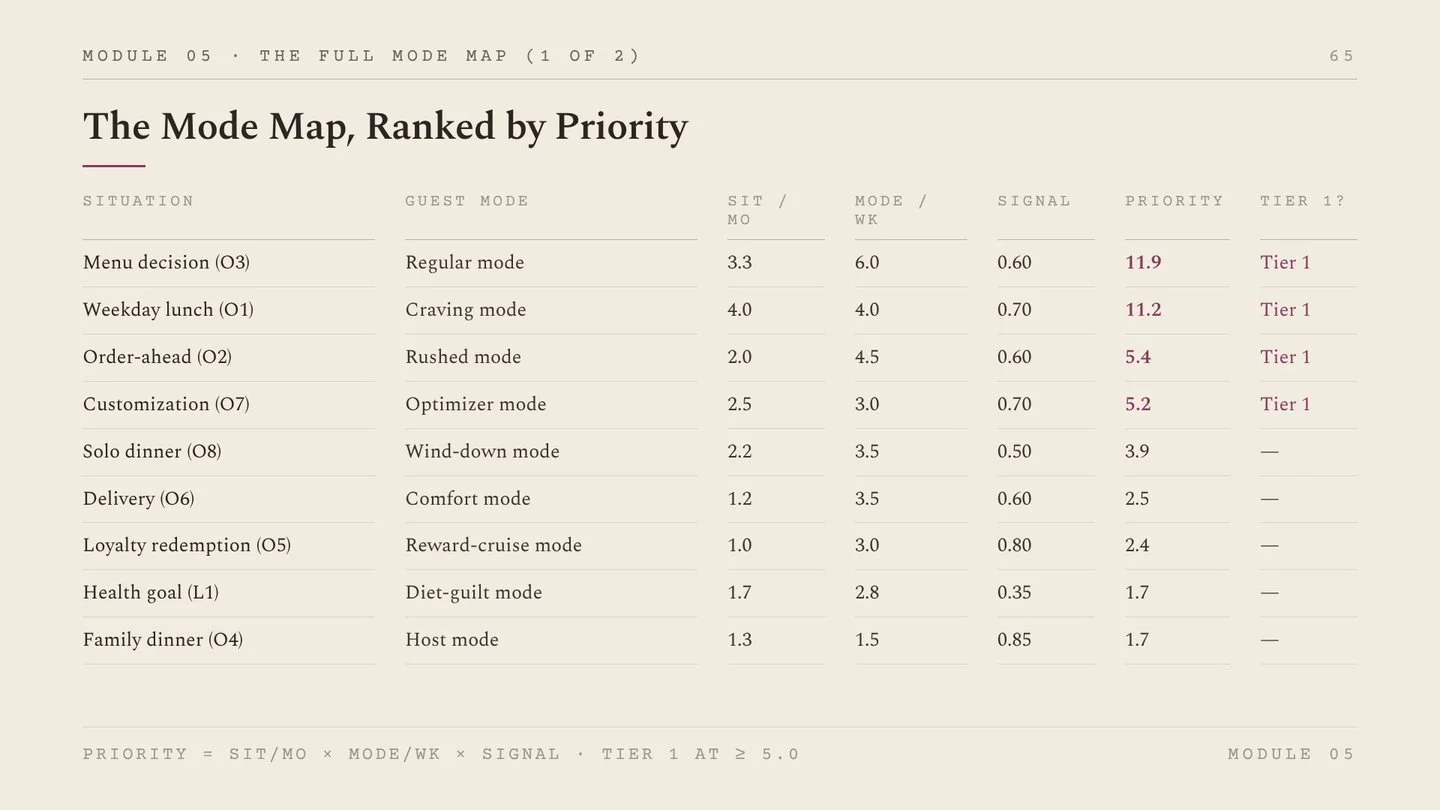
When the workbook crosses situations with modes, only four intersections clear the Tier 1 bar, and all four are routine and positive: the menu decision in Regular mode, weekday lunch in Craving mode, order-ahead in Rushed mode, and building the bowl in Optimizer mode. Those four are where delivery agents and fee-free apps already compete hardest.
Guest modes
A situation tells you when a guest needs you. A mode tells you how. A mode is a temporary mindset and set of behaviors, with a beginning, a duration, and an end. Two guests can hit the same price increase in different modes. One is calmly optimizing her rewards. The other is in budget-panic, sure she can't afford it.
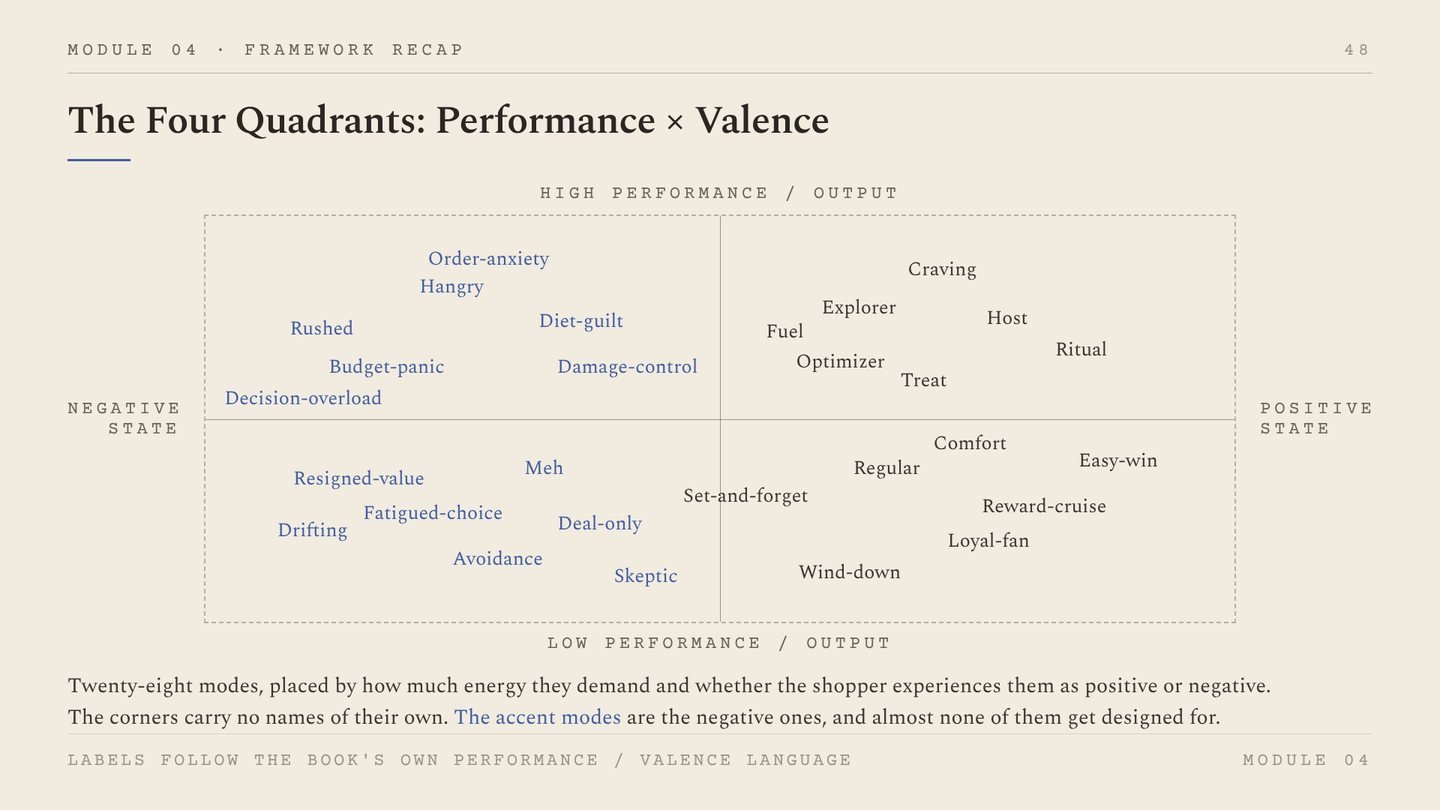
Freshfield's inventory found 28 guest modes, seven in each corner of the book's two axes: performance (how much energy the mode demands) and valence (whether the guest experiences it as positive or negative).
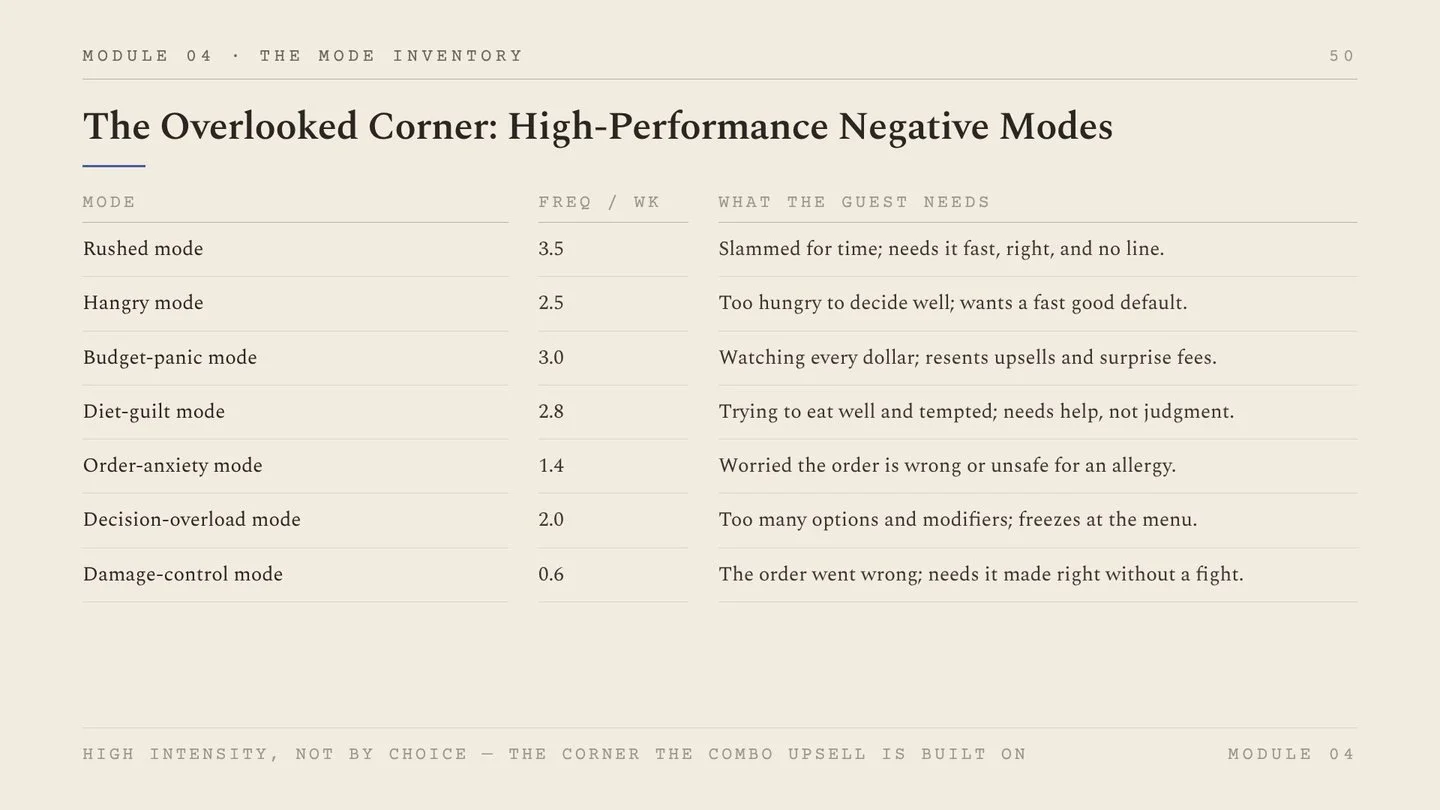
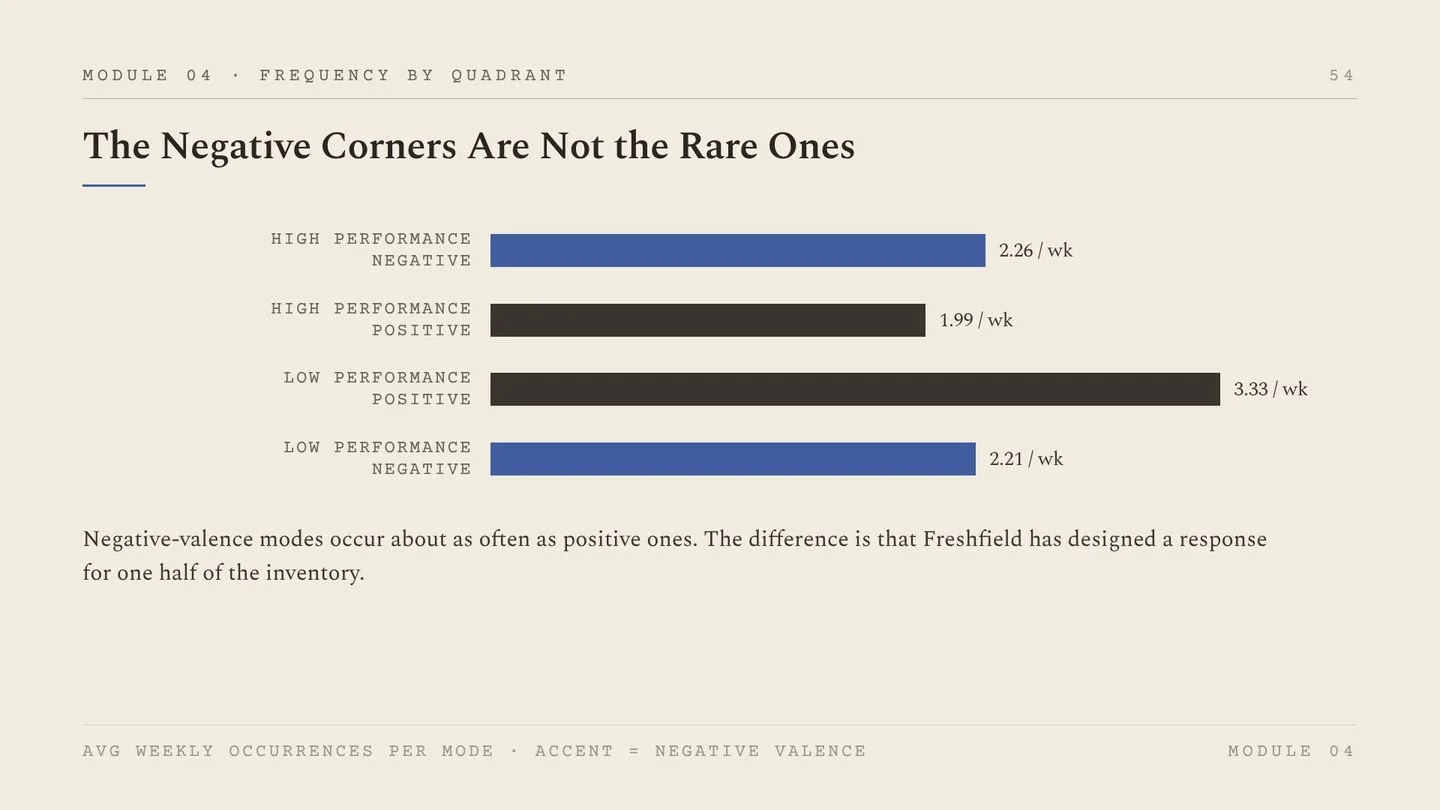
Look at the high-performance, negative corner: Rushed (3.5 times a week), Budget-panic (3.0), Diet-guilt (2.8), Hangry (2.5), Decision-overload (2.0), Order-anxiety (1.4), and Damage-control (0.6). Those are some of the most common food modes in the inventory, and today they get a combo upsell. The book calls this the most overlooked quadrant: the guest operating at high intensity, not by choice.
Negative modes come up as often as positive ones. High-performance negative modes average 2.26 times a week in Freshfield's model, more than the high-performance positive modes at 1.99. Freshfield designs for Craving, Optimizer, and Ritual, the modes that lead to a bigger check, and has almost nothing for the other half.
One guest, three modes
Priya orders from Freshfield three times in one week. Tuesday at 12:10 she's in Rushed mode, slammed between meetings, and needs the usual, ready, with no line. Friday at 7 she's in Treat mode and wants the new item to be worth the price. Sunday morning she's in Fuel mode, meal-prepping three bowls for the week, and the macros matter.
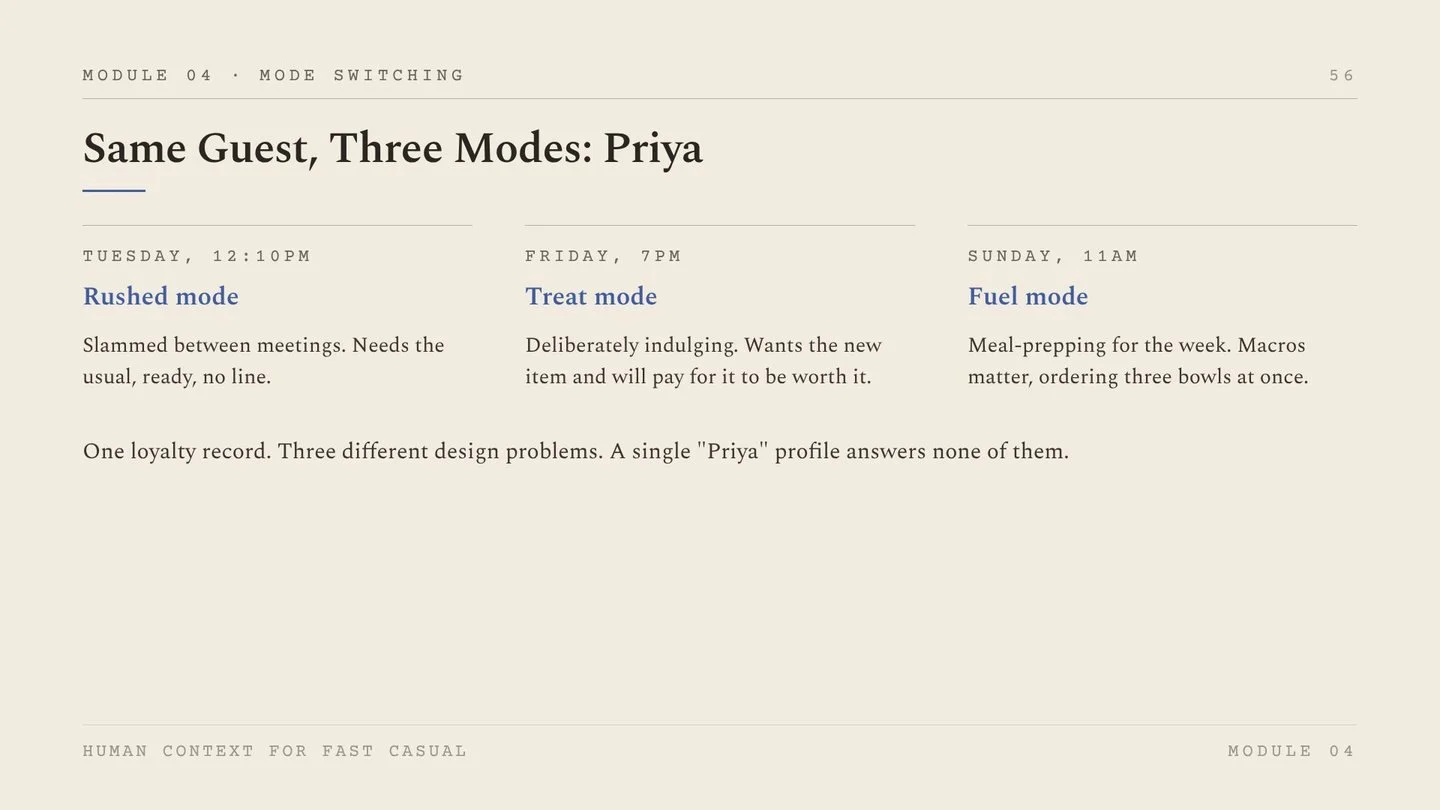
One loyalty record, three design problems. An assistant sees one Priya with one order history, and the right answer changes with each mode.
Same situation, different mode, one assistant answer
Modes and needs from the companion Freshfield analysis; the assistant's answer is illustrative
| Situation | Mode | What the guest needs | The assistant's answer |
|---|---|---|---|
| Deciding what to get | Regular | The usual, fast, no effort | Reorder the usual |
| Deciding what to get | Treat | Something new that's worth it | Reorder the usual |
| Deciding what to get | Diet-guilt | Help, not judgment | Reorder the usual |
| Prices keep climbing | Budget-panic | No upsell, no surprise fees | A cheaper bowl somewhere else |
| Prices keep climbing | Resigned-value | A reason to believe the price | A cheaper bowl somewhere else |
| The order's wrong | Damage-control | Made right without a fight | A refund request link |
The assistant gives a sensible functional answer every time, and the same answer to every mode. The emotional job inside the situation is where a chain can still be the one that showed up.
§ The empty column
Budget-panic mode is produced by the two highest-frequency doubt situations, prices climbing and the budget squeeze, both Tier 1. Yet every intersection it appears in carries a negative buying signal, so it never once clears the Tier 1 priority bar.
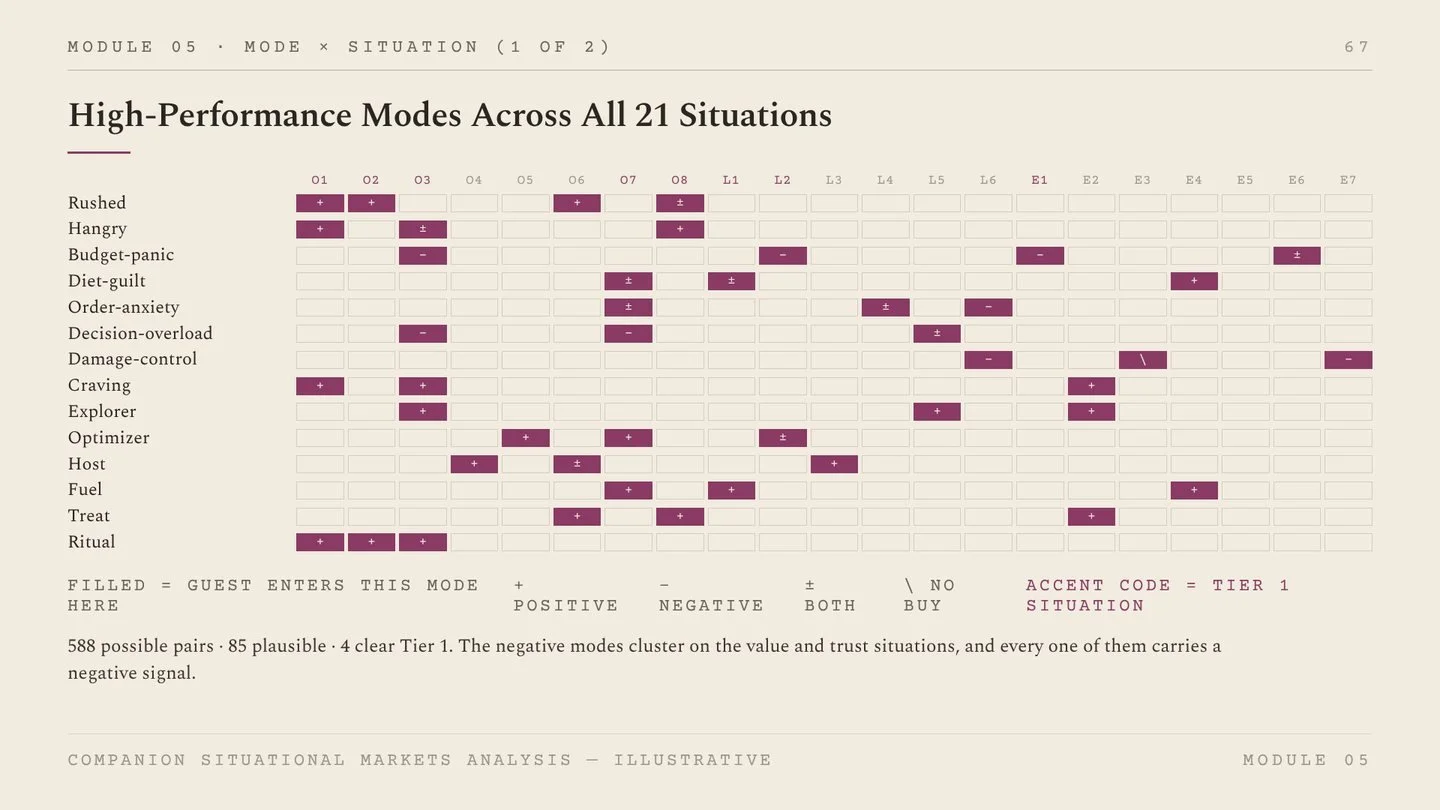
The workbook calls this guest the Value-Doubting Guest: frequent, and never a design priority, because a priority score built on volume and buying signal will always rank her last. An assistant optimizing on price will send her to the cheapest bowl in range. A chain that reads the mode can answer her with the best-value build, a clear total, and no combo prompt, and keep her.
What the assistant takes, and what's left
Guests hire a fast casual meal to get five kinds of jobs done: functional, emotional, social, aspirational, and systemic. The systemic job holds the others together: help me run my week.
| Job | What the assistant does | What the chain has to do |
|---|---|---|
| Functional | Picks the place, places the order, finds the best price, tracks the delivery | Make ordering agent-ready, with your loyalty and the guest's saved build attached. |
| Emotional | Finds a cheaper option and stops there | Design for budget-panic, diet-guilt, and order-anxiety. Read the value doubt at the order. |
| Social | Collects the team's lunch requests and sorts dietary needs | Make the group order and the weeknight family dinner go right, with someone accountable when they don't. |
| Aspirational | Tracks calories and protein | Help the guest eat the way she's trying to eat, using what only the kitchen knows about the food. |
| Systemic | Wants to run the week's meals and the food budget | Be the kitchen the assistant defers to, because it trusts what you serve and how you fix it. |
People build life systems, organized routines and relationships, to hold their lives together. Human Context names nine. Freshfield lives in two of them, consumption and routine responsibilities, and reaches into physical health, financial management, and family togetherness at their most charged moments: the health goal, the tight month, the weeknight dinner nobody agrees on.
A brand has to earn its role in a life system. The assistant is applying for the routine responsibilities system, lunch as logistics. A chain's opening is the charged moments it borrows from health, money, and family, where the guest needs someone who knows the food.
Trust and the Defining Moments
When an assistant places the order, the chain keeps fewer touchpoints. It still owns the kitchen, the pickup shelf, the handoff to the courier, and the fix when something goes wrong. Freshfield's workbook scored ten touchpoints on time value: did it do the job, was it worth the time, and was the time any good.
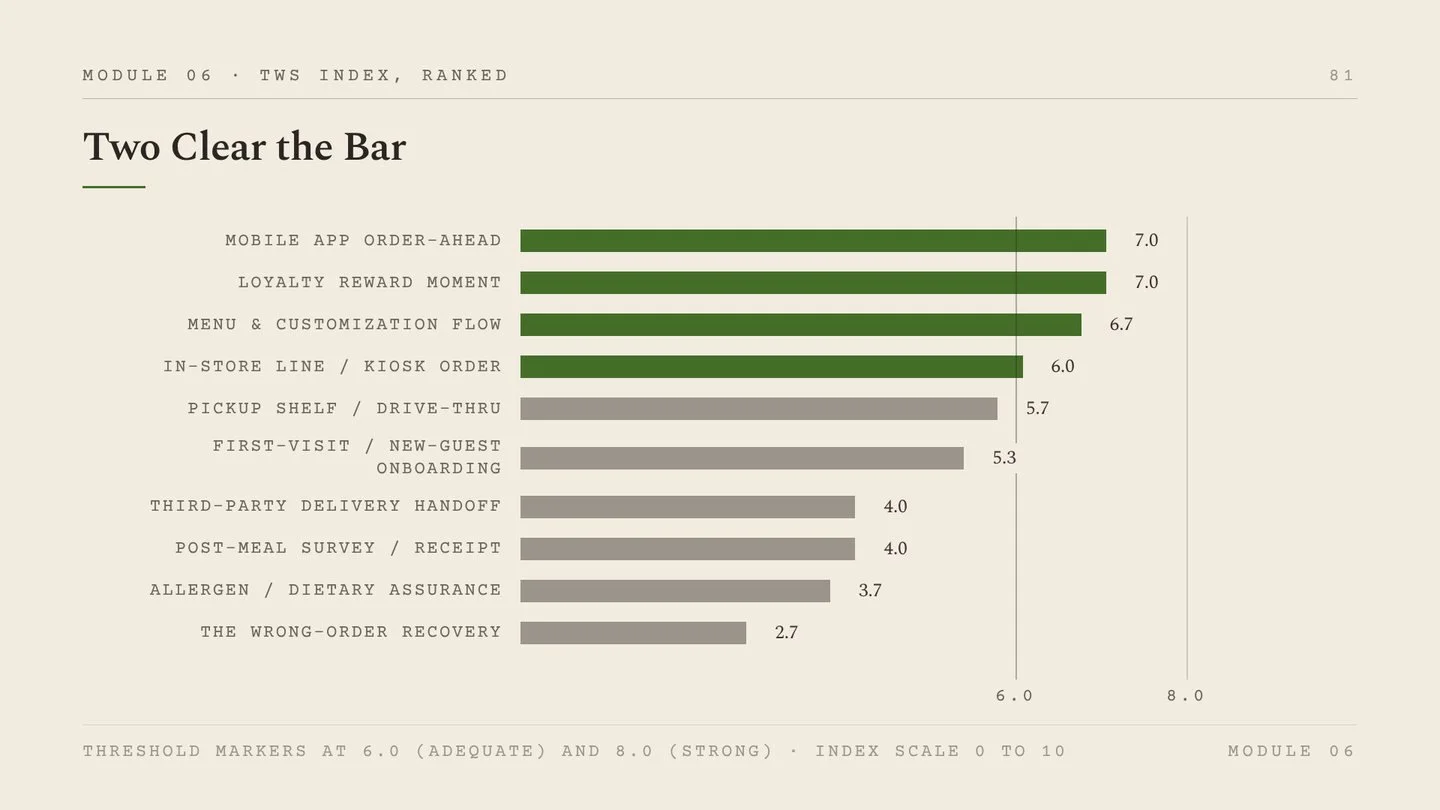
Two of ten cleared the 7.0 bar: app order-ahead and the loyalty reward moment, both at 7.0, both designed on purpose. The third-party delivery handoff scored 4.0. The two lowest scores belong to the two Defining Moments, the events that decide the relationship in hindsight. Allergen and dietary assurance scored 3.7, answered with a disclaimer. The wrong-order recovery scored 2.7, the lowest of anything Freshfield does, run as a refund queue.
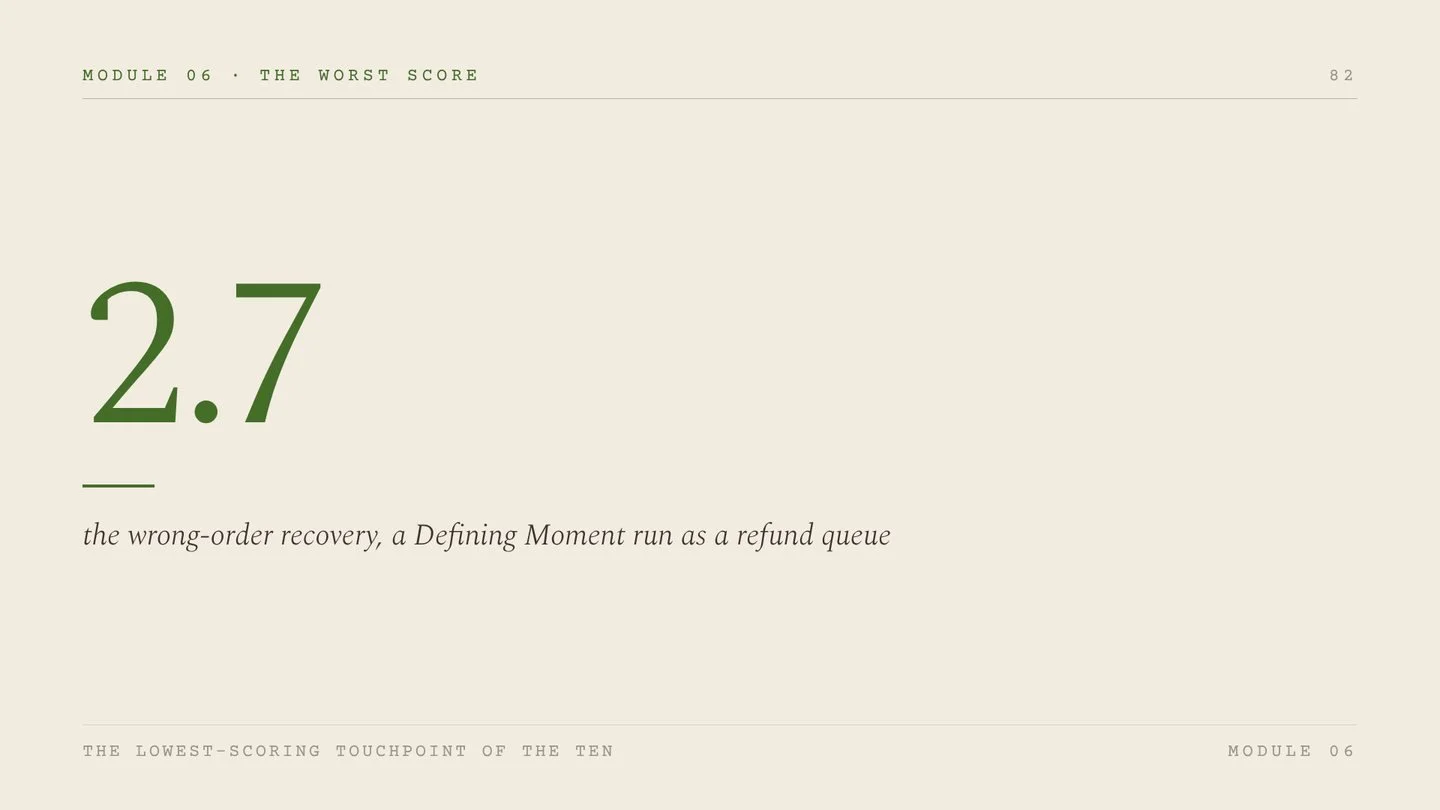
Those are the touchpoints a chain keeps after the assistant takes the order, and they're the ones it runs worst. An assistant can file the refund request, but remaking the bowl or telling a guest with a sesame allergy what's in the dressing takes the restaurant.
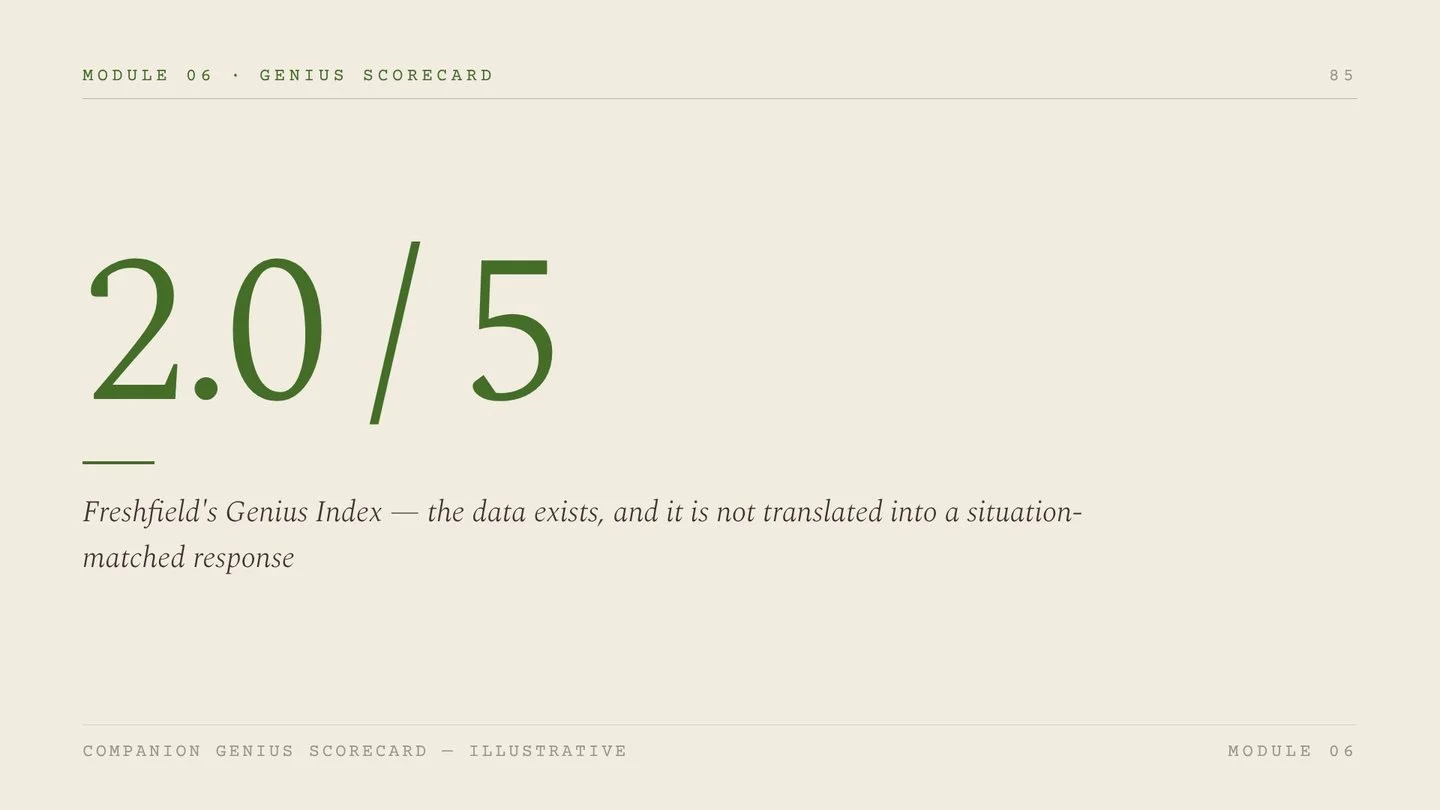
The workbook also scored Freshfield on five diagnostics for AI-driven experiences. Its Genius Index came out at 2.0 of 5. Mode Match scored 1: a budget-panic order and a craving order see identical prompts. Freshfield already has the data that shows the mode (short, fast repeat sessions read as Rushed; a stripped-down cheapest build reads as Budget-panic). It still shows every guest the same prompt.
Six steps for fast casual chains
- Build your own door for agents
Publish an ordering connection that Muse, DoorDash's agent, and Gemini can call directly, with your loyalty program and the guest's saved build attached. Making it easier for someone else's assistant to order from you may seem counterintuitive. But if your company is going to win with Human Context and AI, you have to be in the game. Don't let a marketplace be the only way an agent reaches your kitchen.
- Read the value doubt first
Start with the guest in budget-panic. When the session reads that way, show the best-value build and a clear total, and turn off the combo prompt. Freshfield's first pilot does this at the order.
- Rebuild the two Defining Moments
Make the wrong-order fix take seconds, with a remake or credit offered before the guest asks. Make allergen assurance a confirmation of what's in her order. These are the touchpoints left when the assistant places the order.
- Tie loyalty to the guest
Points and perks should follow an agent-placed order, so your loyalty members still count when they never open your app.
- Retire the daypart
Write your situations in the guest's words as "When I…" statements, size them, and cross them with modes. Find the frequent mode that never clears the bar.
- Measure time value
Replace the satisfaction average with a time-value index on every touchpoint. Score the Defining Moments first, and switch off anything that is worse than nothing.
Three questions for your leadership team
If the answer is only your price and your menu, it will pick on price.
List them. Then check how they score.
She is in your Tier 1 situations every week, and today she gets a combo.
Human Context for Fast Casual
I wrote Freshfield Kitchen in July, before Muse launched. Read it now and it reads like a rehearsal. Each challenge in this paper has a module that works through it on a chain's own operations, with a blank worksheet for your team at the end.
| The challenge | What Freshfield found | Module |
|---|---|---|
| Guests judge you against the app that made ordering easy last night, and now against an assistant | Zero touchpoints read the guest's situation | 01 · Where the Goal Posts Moved |
| Assistants take the routine order | 21 situations, 21B occasions; five of eight Tier 1 situations are routine | 02 · Situational Markets & Menu AI |
| Dayparts can't see what the assistant sees | One guest, three situations, one daypart | 03 · Retire the Daypart |
| Muse can't read modes | 28 modes; Rushed, Budget-panic, and Diet-guilt get an upsell | 04 · Getting Into Guest Modes |
| The value doubt never becomes a priority | The empty column: the Value-Doubting Guest | 05 · Life Systems & the Mode Map |
| Defining Moments decide who keeps the guest | Wrong-order recovery at 2.7 and allergen assurance at 3.7; two of ten touchpoints clear 7.0 | 06 · Measuring Impact |
Freshfield Kitchen is an invented composite. The chain is made up; the problems are real
Three ways in
 The book
The full method: situational markets, modes, life systems, and time value, with the research behind each.
The workbook
Six modules and blank worksheets your team can fill in with your own numbers, plus the Freshfield case study.
Two virtual two-hour sessions about three weeks apart. Your team leaves with a first map of your situational markets, frequency estimates on the largest, a situation calendar, and a 90-day plan.
To book the workshop or talk through what Muse means for your restaurants, email me at davenorton@stonemantel.co or call 719.232.0721.
The assistants are already reading the order history. Within a few years they will decide where a lot of Americans eat lunch, and they will start with the guests who were only coming back out of habit.
Notes
- PYMNTS, "Meta's Muse Can't Order a Pizza Without Help," Sept. 9, 2026.
- PYMNTS, "DoorDash Opens Beta Waitlist for AI Text Ordering," Oct. 1, 2026 (citing Bloomberg, DoorDash, and InfoQ).
- Nicole Silberstein, "DoorDash, Uber Test Out True Agentic Ordering in Google Gemini," Retail TouchPoints, March 3, 2026.
- PYMNTS Intelligence, "Loyalty Programs Drive Nearly Two-Thirds of Restaurant Delivery Decisions," Feb. 24, 2026.
- MarketBeat, "Chipotle Mexican Grill Q2 Earnings Call Highlights," July 29, 2026.
- Sweetgreen, Inc., second quarter fiscal 2026 results, Form 8-K, U.S. Securities and Exchange Commission, 2026.
- U.S. Bureau of Labor Statistics, Consumer Price Index, August 2026, released Sept. 11, 2026.
- DoorDash for Merchants, "Commission Rates & Pricing," reviewed October 2026.
- Stone Mantel, Human Context for Fast Casual and the companion Freshfield Situational Markets Analysis, July 2026 (citing Circana, 2025, and Technomic, 2025).
- Stone Mantel, Freshfield Kitchen case study, July 2026.
- David W. Norton, Ph.D., Human Context: How Intelligent Companies Build Customers, 2026.
Freshfield Kitchen is an invented composite fast casual chain, not a real business. Its figures come from a companion analysis Stone Mantel built for the workbook; the inputs are illustrative composite estimates chosen to demonstrate the method, not findings from a real chain. The prologue scenario and the projection are illustrative. © Stone Mantel 2026.